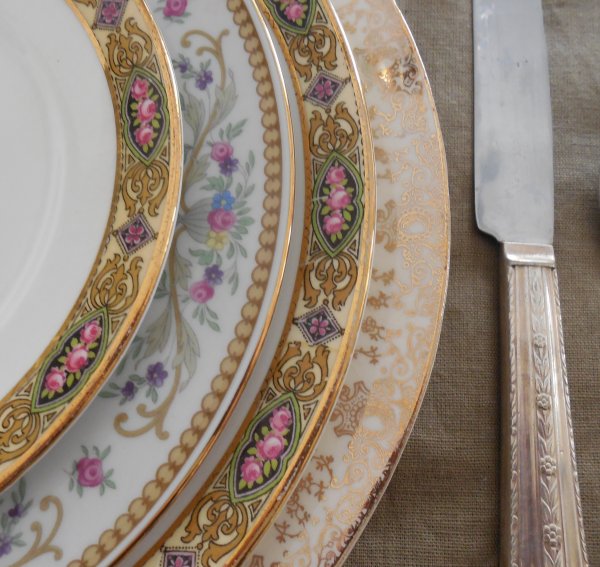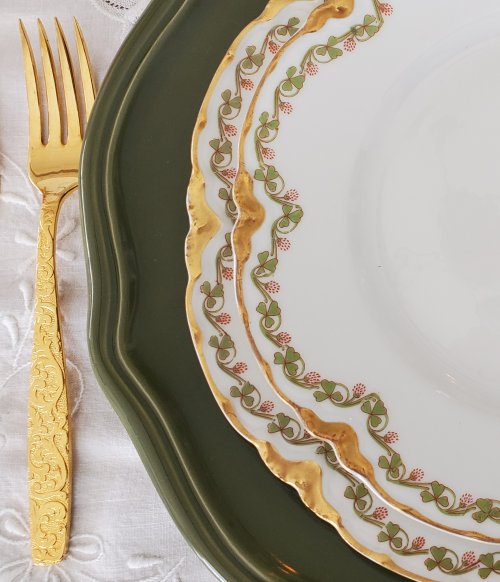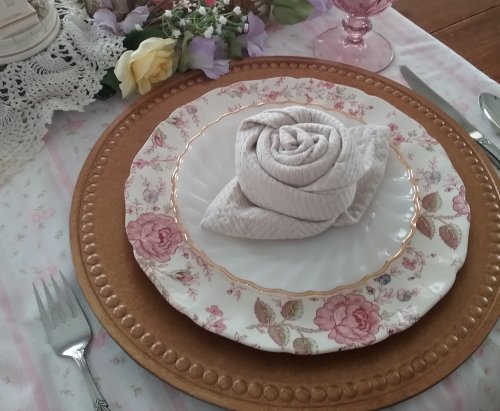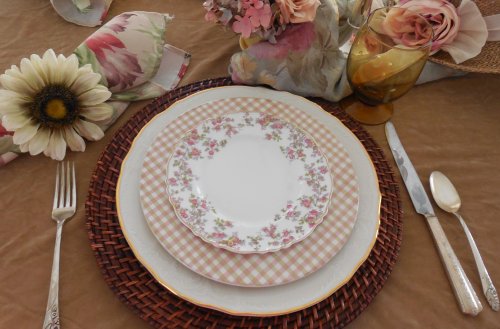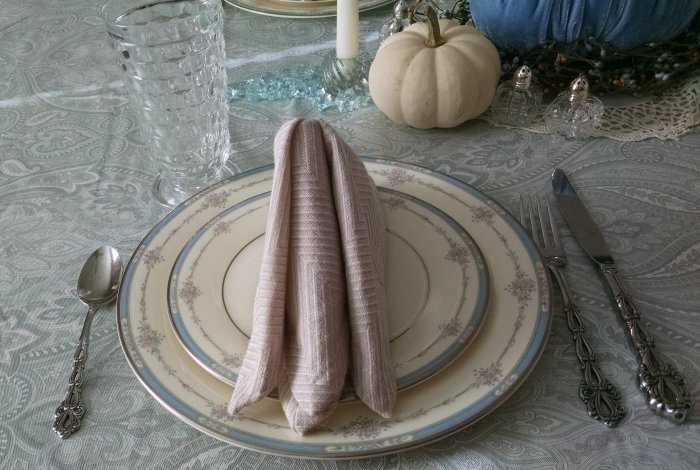
Tablescaping 101: Choosing flatware for your tablescape

Affiliate links may be used in this post. Please see my disclosure statement.

Welcome back to Tablescaping 101 and today’s hints and tips for how to choose flatware for your tablescape! Before we dive in, here’s a quick re-cap of everything we’ve covered so far:

In our last two lessons, we had a lot of leeway as far as creativity in mixing and matching dinnerware and creating a pretty and interesting centerpiece. The rules are a bit more finite for flatware, and quite honestly I am still a “work in progress” when it comes to placement. (But then, so is my favorite restaurant – apparently I’m supposed to spread the butter on my roll with the same knife I use to cut my steak!)

For me the satisfaction in this step comes from the beauty and timelessness of the pieces themselves: there is just something about placing flatware that says to me, “families have been doing this for generations.” It gives me a sense that I’m connected to a very long timeline of humans sitting down to eat together.

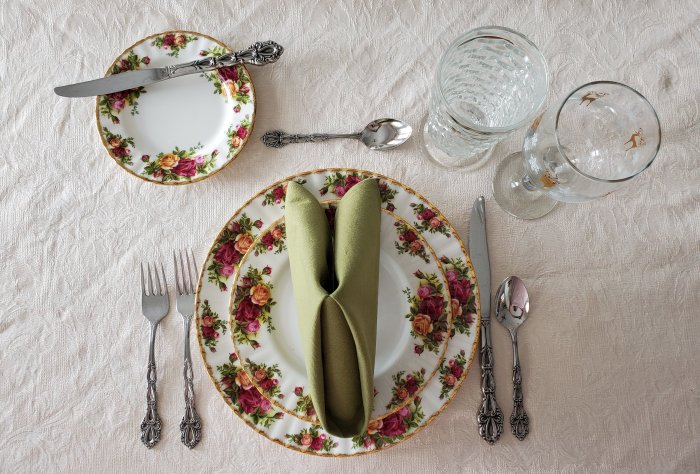
Here are the basic guidelines again for a formal place setting.
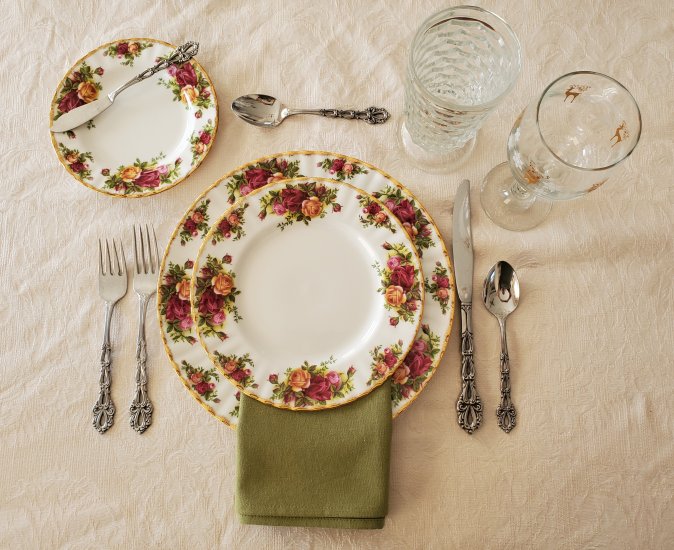
Formal place setting | Vintage Floral Cottage
  • Forks on the left side of the plate, with the first course utensil on the far left so that we can work our way in toward the plate with subsequent courses.
  • Knives and spoons to the right of the plate, with the knife closest to the plate then again working our way from the outside in.
  • In a formal setting, a dessert fork or spoon lays horizontally at the top of the plate.
  • A butter knife lays across the bread plate at the upper left of the dinner plate.

Now it’s time to decide what flatware we will actually use, so let’s take a look at some options.

A typical place setting of flatware will come with four or five pieces: generally, a salad fork, dinner fork, dinner knife, dinner spoon, and teaspoon. A soup spoon might be included, or substituted, or available individually as “open stock.”
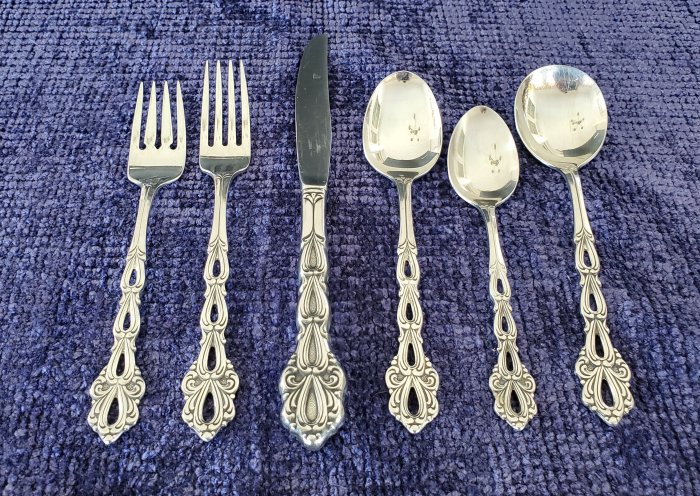
Typical place setting of flatware, left to right: salad fork, dinner fork, dinner knife, dinner spoon, teaspoon, and soup spoon.

Common serving pieces available in the same pattern might be a slotted spoon, platter spoon, and meat fork. These pieces are larger than the individual place setting pieces. A relish spoon and butter knife, smaller than the place setting pieces, may also be available.
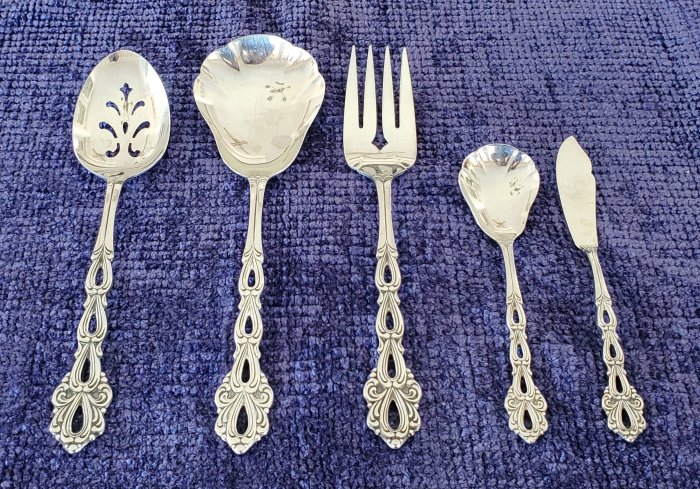
Serving pieces might include, left to right: slotted spoon, platter spoon, meat fork, relish spoon, and butter knife.

The above are just the most typical place setting and serving pieces. There are dozens of utensils for individual food items and serving purposes, especially in vintage flatware sets!

The flatware (or silverware) you choose for your table will depend primarily on what food you’ll be serving, what you have available, and what complements your tablescape design, theme, or color scheme. Speaking personally, my preference is for flatware to match, as opposed to the dinnerware which I love to mix. I do make an exception: I have a hard time resisting vintage silverware at flea markets because it’s usually dirt-cheap when sold by the piece. I have many pieces that I acquired for fifty cents or a dollar each, so I do mix-and-match those.

When I first started setting pretty tables, I only had one set of flatware. It was the beautiful and versatile stainless “Chandelier” by Oneida that I inherited when my great-Aunt passed away, and I’ve actually been using it daily for about 30 years.
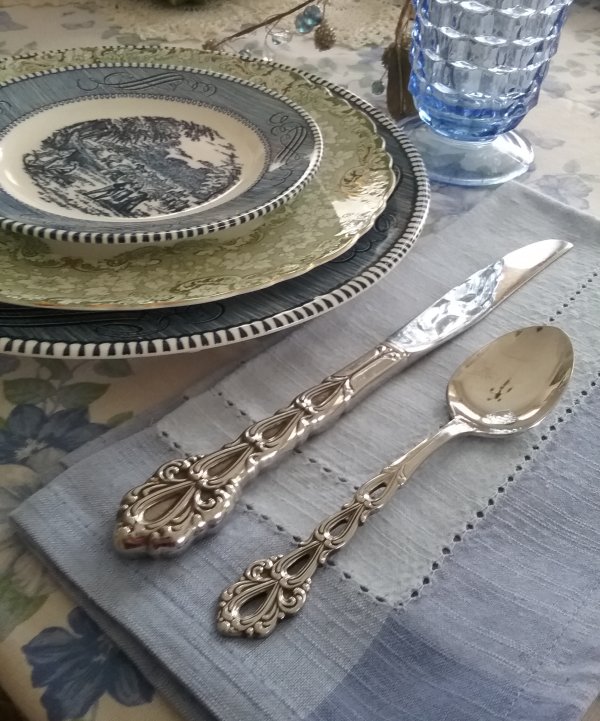
Oneida “Chandelier” stainless steel – inherited from my Great-Aunt. I have service for 8 in this set plus many serving pieces.

As my stash of vintage dinnerware grew, though, so did my desire to own and try different types of flatware. I haven’t branched out too far in this category, but I do now have a few options that I’ve chosen very carefully for the distinct features that each brings to the table. Point being, don’t worry if you only have one set of flatware, but do know that there are many options out there if you are thinking about venturing past your everyday set!

Here are some of the options, and my personal thoughts on when to use them:

Silverware (or silverplate) is the stuff you polish. It has a beautiful and traditional heirloom quality about it. For me, real silverware is for tables that need a true vintage feel. It looks positively magical in candlelight.
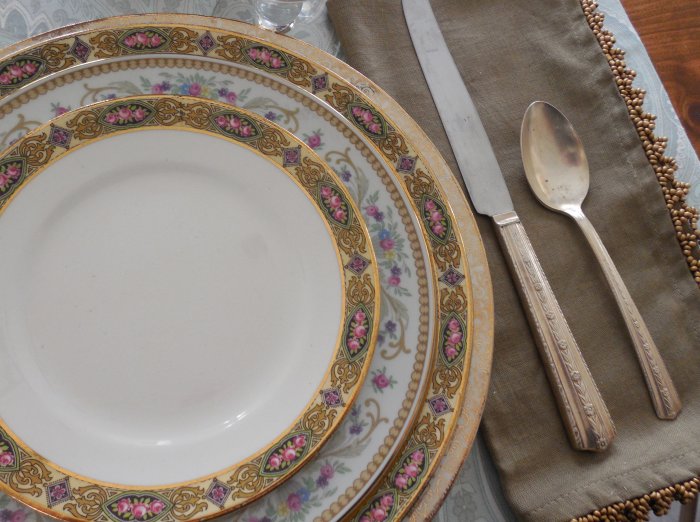
Beautiful vintage silverware is generally inexpensive at flea markets, and adds a true vintage feel to any table – even one with lots of gold edges 😉

Stainless steel (“stainless”) is a more modern alternative to silverware and doesn’t need polishing. I use my Oneida if an elaborate pattern fits the theme or if I need special pieces like a soup spoon, because that is my largest set.
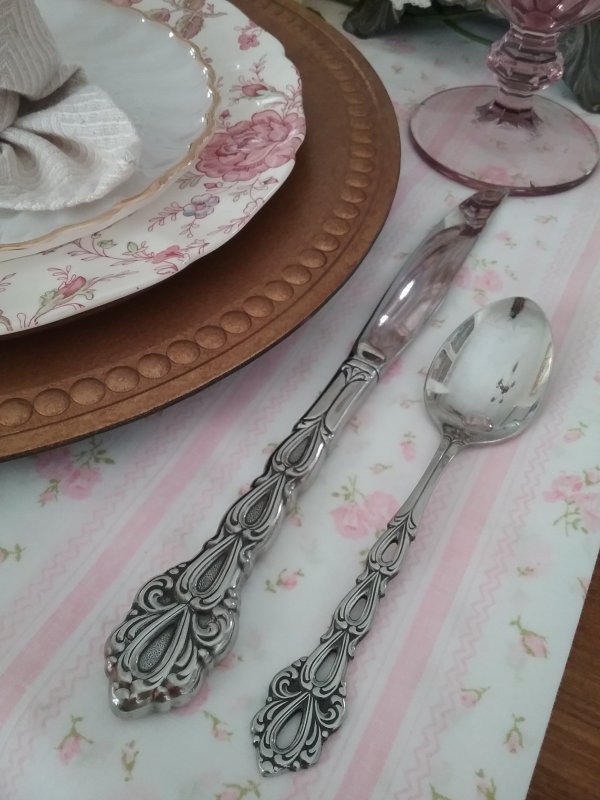
I also used my Oneida last year for my Halloween tablescape, because once I put it with the other table elements it seemed to take on a very “Gothic” vibe – perfect for that particular table!
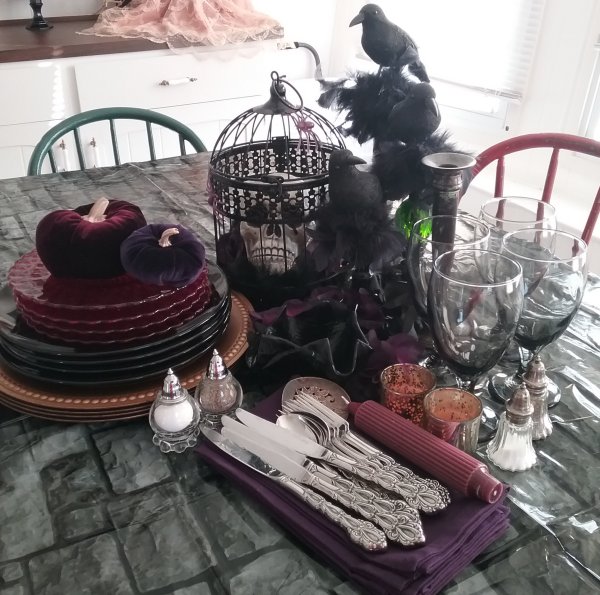
A spooky, Gothic Halloween tablescape… Oneida “Chandelier” acquired a different personality when set with these elements!

Also in the stainless category, I love to use Wallace Napoleon Bee for a table that has a nature or garden theme.
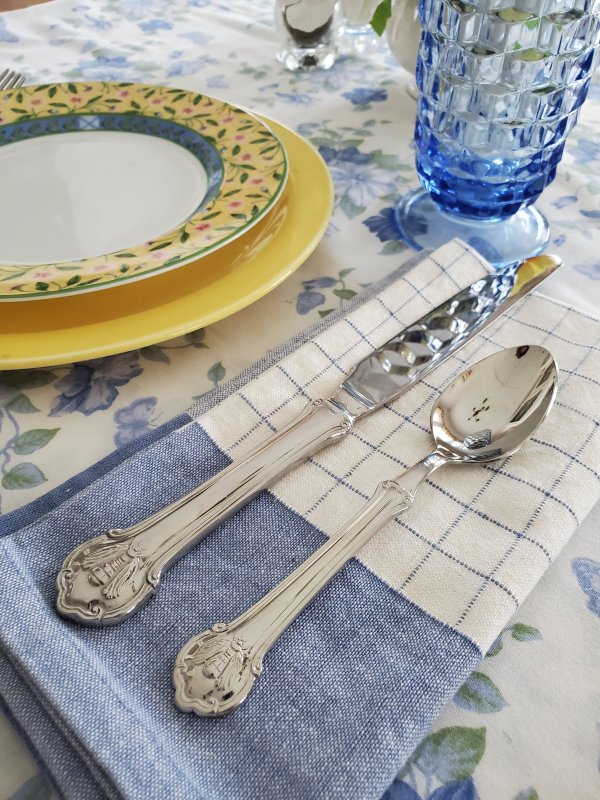
Napoleon Bee by Wallace is wonderful, especially in a garden-themed table setting.

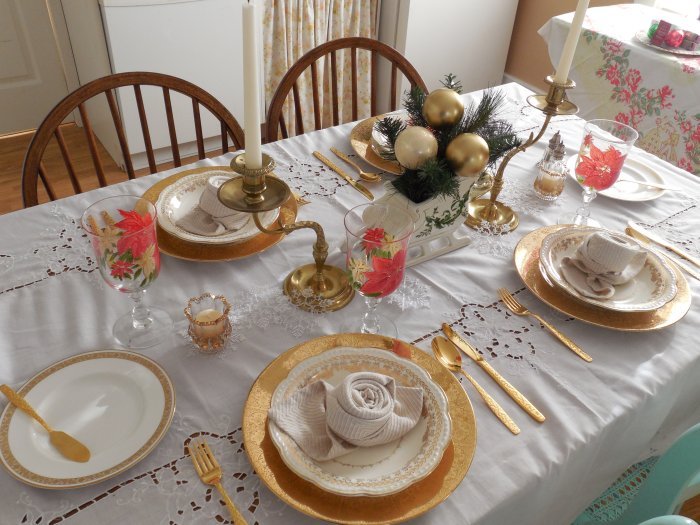
Gold electroplate adds extra opulence and sparkle to a table where the dinnerware has those beautiful gold edges or where gold is part of the theme. It also looks great at Christmas. I have a small set of “Americana Golden Heritage” by International Silver, acquired at a vintage mall, that I use whenever I need to go “over the top” on gold accents. This set has a few serving pieces, too. It’s also beautiful in candlelight.
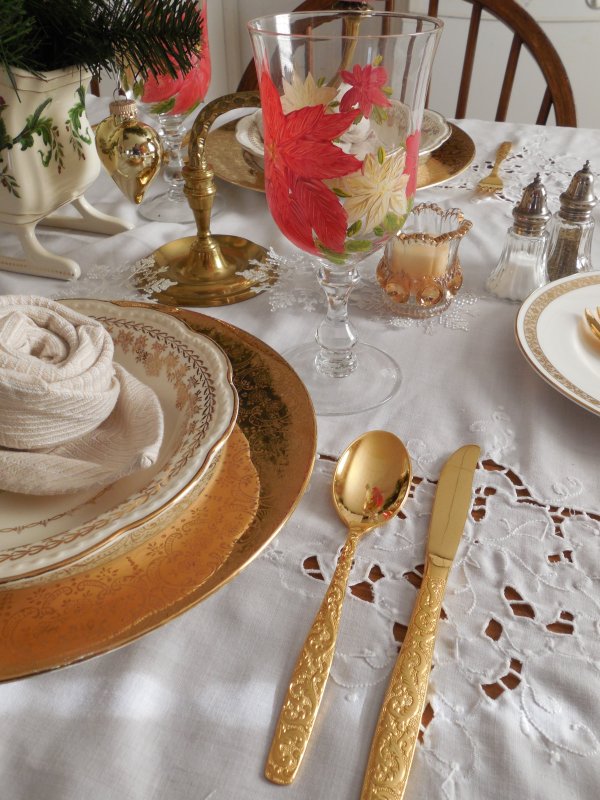
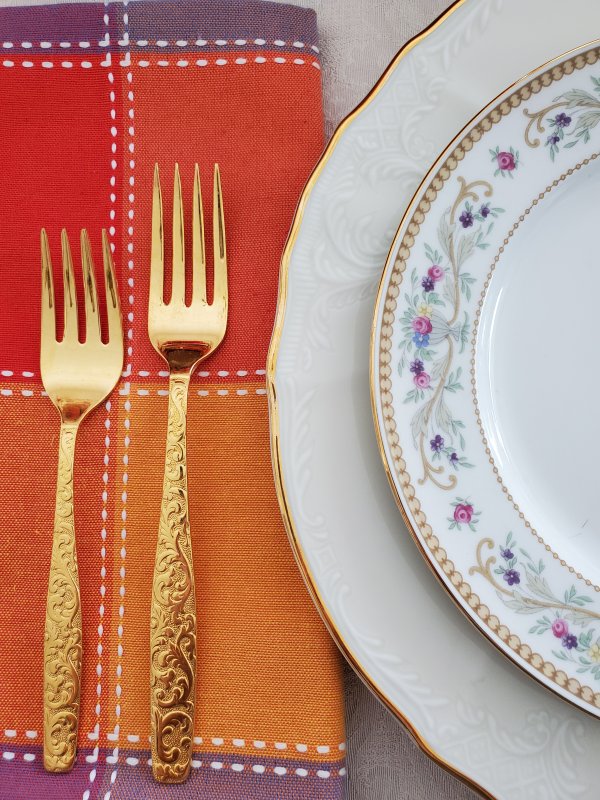
“Americana Golden Heritage” by International Silver, used in a gold-themed Christmas table. Can you tell which rule I broke when setting this table three years ago? 😀
“Americana Golden Heritage” by International Silver.

Plastic/acrylic, primarily in the handles. There are lots of choices in composite flatware where the utility end of the piece is stainless, but the handle is encased in another material. A style with a riveted handle has been popular – and available in many colors – for decades. And, this style – in every available color! (LOL) is on my list for someday. I do think you have to be cautious with plastic-handled choices – read directions carefully regarding suitability for the dishwasher.

Most of my personal choices have a vintage feel to them, because “vintage” is my style. There are also a gazillion options with a much more modern vibe: Colorized stainless is a very modern choice, and so are highly stylized looks such as this twig-handled design.

Flatware is really a challenge for me – I don’t have a wide selection of large sets. Also, in daily practice, I tend to set the table with one fork because I don’t use a lot of salad plates so it is easy for me to neglect the “fork side” of the plate if I’m setting purely for creative purposes. If I were having actual invited guests, I would set more formally or perhaps have the wares for an entire course (such as dessert) set out on the sideboard to bring to the table after it’s cleared.
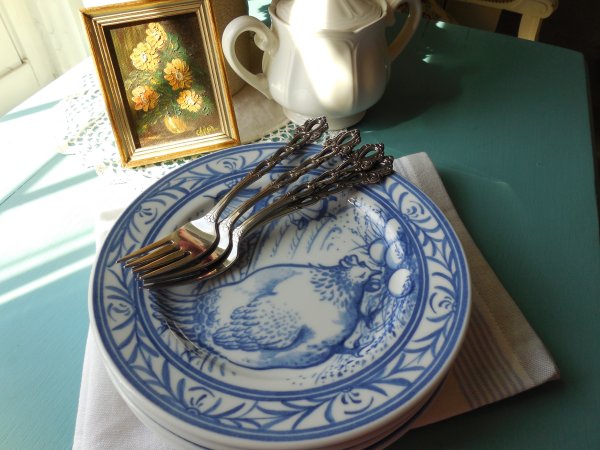
“Farm Animals” by Williams-Sonoma set aside for dessert with “Chandelier” forks by Oneida. Time for apple crisp!

Posted in Tablescapes | Leave a comment

Tablescaping 101: How to create a centerpiece for your tablescape

Welcome back to Part 4 of my blog post series, Tablescaping 101! In previous posts we’ve covered the basics of a proper table setting, planning a tablescape, and creating a pretty mix-and-match stack of dinnerware.

In this post we’ll take a look at how to create a centerpiece for your tablescape – some guidelines for creating them, and some ideas for what to use.

The centerpiece is primarily for visual effect, so it may seem superfluous to an everyday dining table or weeknight family meal. But I think that’s actually its primary benefit, too: it dresses up an everyday event, and makes the ordinary feel special!

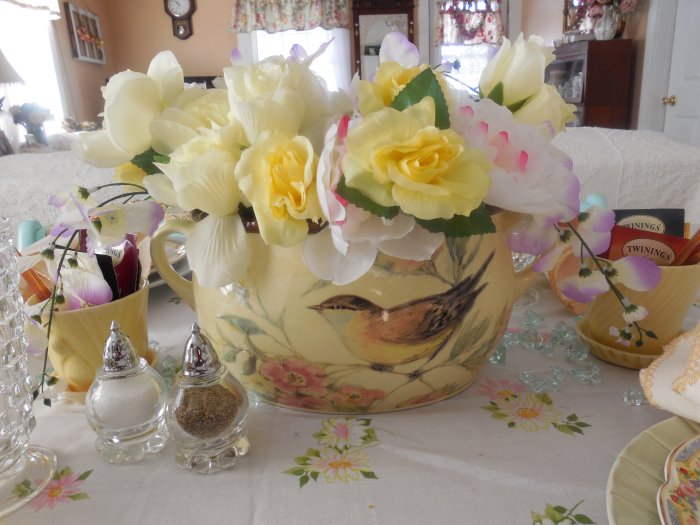
A large oven-safe serving bowl makes a great container for silk or fresh flowers. Yellow all-in-one vintage planters are used to hold tea packets on this pastel-themed Spring table.

It’s my belief that you don’t have to spend a lot of money – or even any money – to make a great centerpiece! You can use inexpensive silk flowers, vases and other containers found in thrift stores, and items found around your home to create memorable centerpieces that enhance your tablescape theme and contribute to the intended ambiance.

The only “rule” for centerpieces is that they should not obstruct conversation across the table. If guests have to peer around to speak to someone on the other side, your centerpiece is at an improper height. Beyond that, Creativity is the name of the game!

Here are some guidelines and tips for creating pretty, budget-friendly centerpieces!

1. Flowers always make a wonderful centerpiece, and in fact the easiest way to make a centerpiece at all is just to plop some flowers (fresh or faux) down into a container and set it in the middle of the table. You can easily do this any time you set the table, but to really elevate the use of flowers, try to use colors or flower types that contribute to your table’s theme or color scheme.

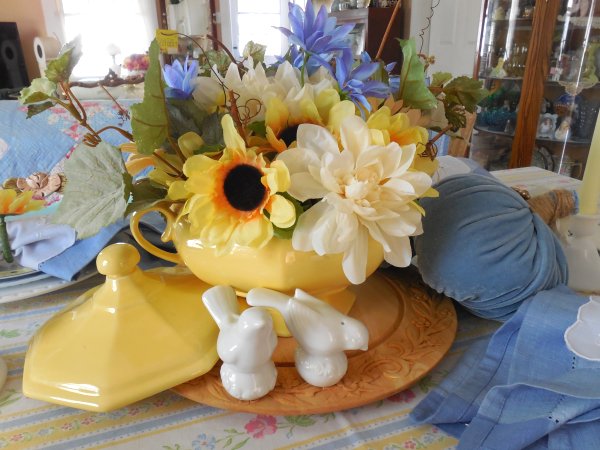
Inexpensive Dollar Tree stems in an amazing yellow soup tureen were the focal point of my blue and yellow “Colors of Provence” table.

Fresh flowers don’t have to be expensive. Check your local grocery store or Walmart to see if they have a flower market – inexpensive “grocery store bunches” are often seasonal in color, and the humble, inexpensive carnation always makes a pretty bouquet perhaps with some gypsophila (“baby’s breath”) for filler. If you have a Trader Joe’s near you, I’ve found that they usually have great prices on fresh flowers!

It’s important to remember that flowers on the table don’t have to be fresh. The vast majority of my centerpieces are made with silk flowers – either high-quality realistic-looking stems or ready-made bunches found in thrift stores, or even arrangements thrown together with fanciful stems from Dollar Tree.

3. Shop second-hand for interesting containers. Vases are the go-to for fresh flowers, of course, but only if they are the right height. The thrift stores are usually full of high quality vases that originated with floral delivery services. You can also use a wide variety of glass, ceramic, or even plastic containers. I’ve used soup tureens, teapots, serving bowls, sugar bowls, mason jars, vintage planters, antique biscuit jars, and all manner of glassware for centerpiece containers!

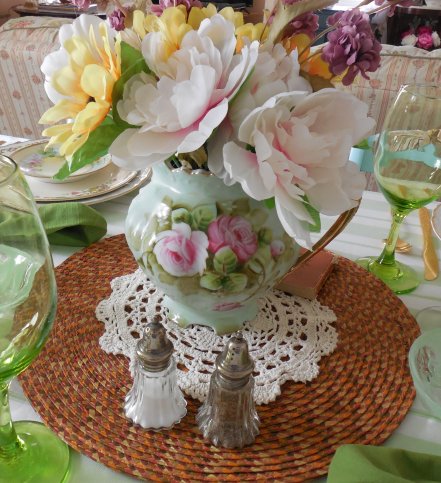
This amazing hand-painted antique Lefton pitcher held a collection of large blooms on my Summer Garden table. Click through to see the full centerpiece.

One of the advantages of using silk flowers is that they don’t have to be in a waterproof container. This broadens your options considerably to include baskets and wooden containers like dough bowls or antique sewing machine drawers.

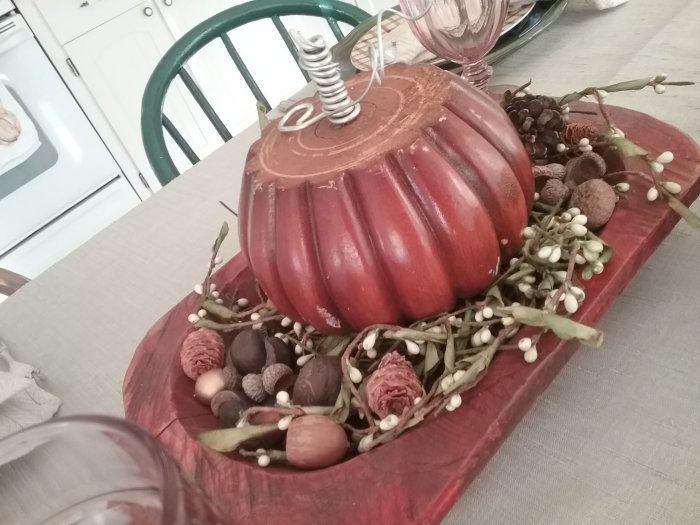
A wooden dough bowl filled with pip berry wreath, natural elements, and a cleverly re-purposed bun-foot from a piece of furniture make a perfect Fall centerpiece!
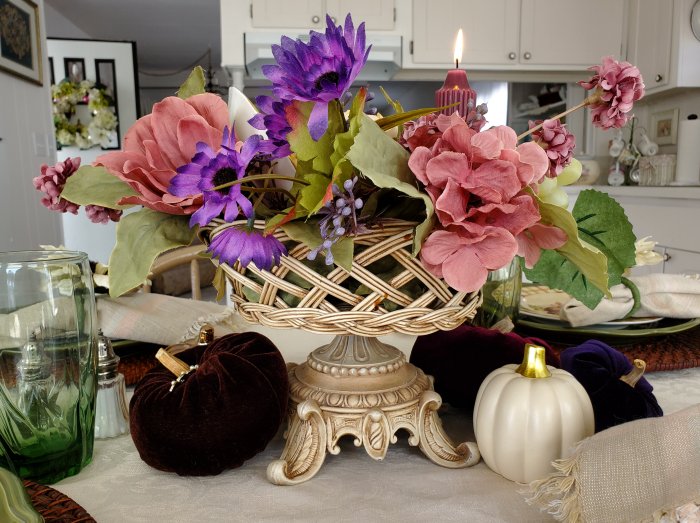
This thrift-store basket-on-a-pedestal is going to be SO versatile! Here it’s styled for Fall, but the contents of the basket can be easily changed out for any reason or season!
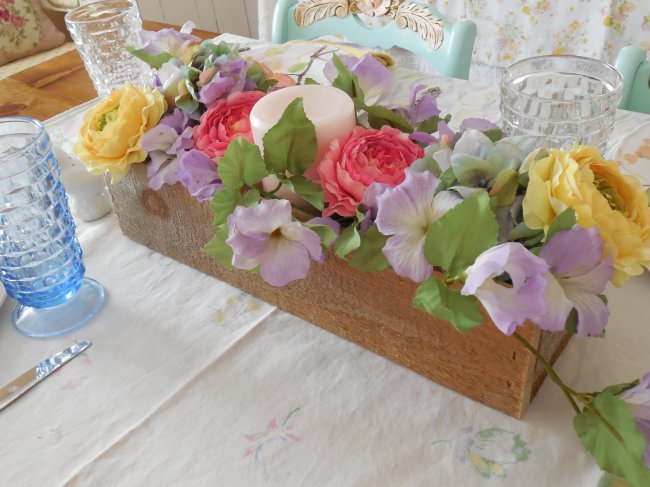
A simple wooden box hand-built by my handyman sweetie holds pretty silks (the pink and yellow roses are napkin rings!) and a scented candle.

4. Skip the container altogether. Sometimes I like to just design what I call a “runner” – an arrangement of objects that runs a portion of the length of the table. I usually use a piece of fabric or some type of silk floral wreath or garland as a base, and just arrange objects along the length. You can build this type of arrangement with the tallest/largest object in the center, then shorter items eminating out from there. Or, have pieces at either end that “anchor” the arrangement.

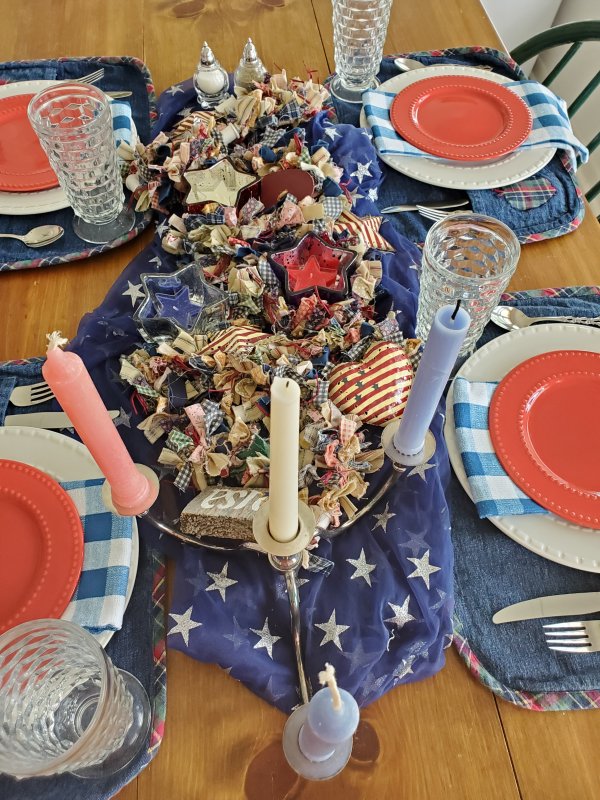
Patriotic tablescape: An eight-foot fabric garland sits atop a blue sheer with silver stars. Other interesting patriotic bits are scattered throughout including tin stars and hearts, glass star-shaped candles, and small hand-painted wood chunks proclaiming “USA.”
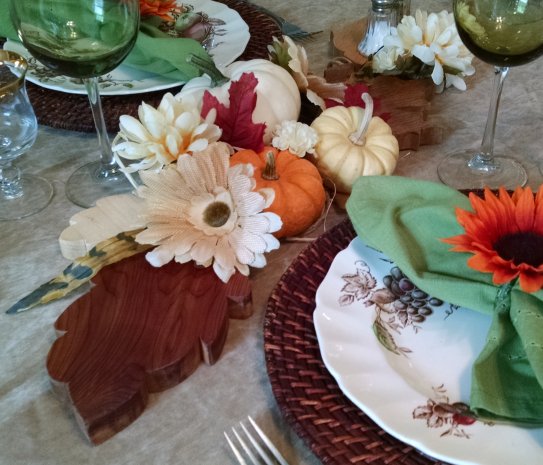
Another runner-style centerpiece – this one features an autumn door swag of wooden cut-out leaves, silk blooms and leaves in Fall colors, and tiny real gourds.

5. Accessories in your centerpiece might include candlesticks or votive holders (with candles of course) and “table scatter” such as faux jewels, half-round glass marbles, nuts and acorns gathered on a nature hike, or foil confetti in holiday shapes. I often incorporate my salt and pepper shakers into the centerpiece, as well, instead of just “setting them out.”

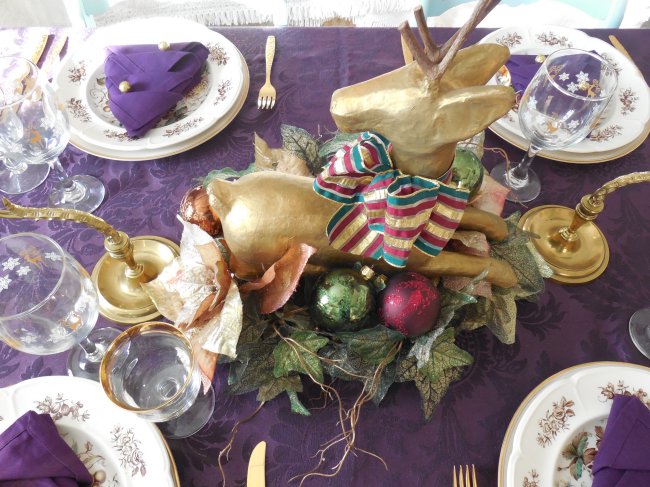
A gold-painted deer on a nest of shimmery silk ivy was the star of this centerpiece for a jewel-toned Christmas table.
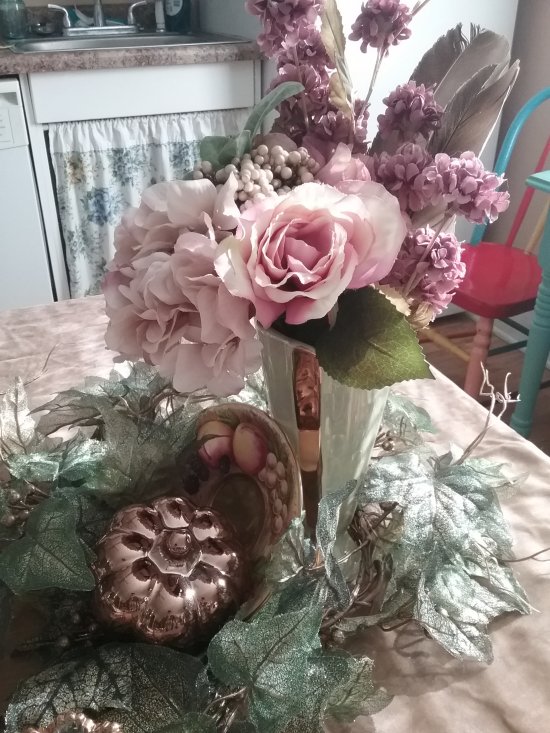
Some of the elements we’ve seen before combined in different ways. Silk flowers are accompanied by real goose feathers, and a glimmering gold saucer is nestled in for its harvest theme and Fall colors.

6. Include some conversation starters! I love to use unexpected objects in my centerpieces that encourage guests to ask questions or share personal anecdotes. Examples of this include my great-Aunt’s antique wildflower field guide, my handmade velvet pumpkins, a china saucer nestled into a flower arrangement, small hand-painted wooden signs, jewelry, small figurines, even a garden hat!

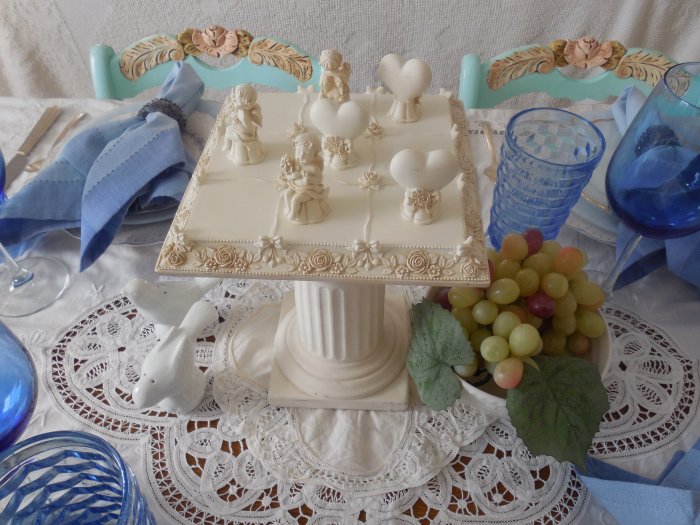
A “Gal-entines table” featured this amazing thrift store score: a resin tic-tac-toe board with hearts and Cupids for the playing pieces!
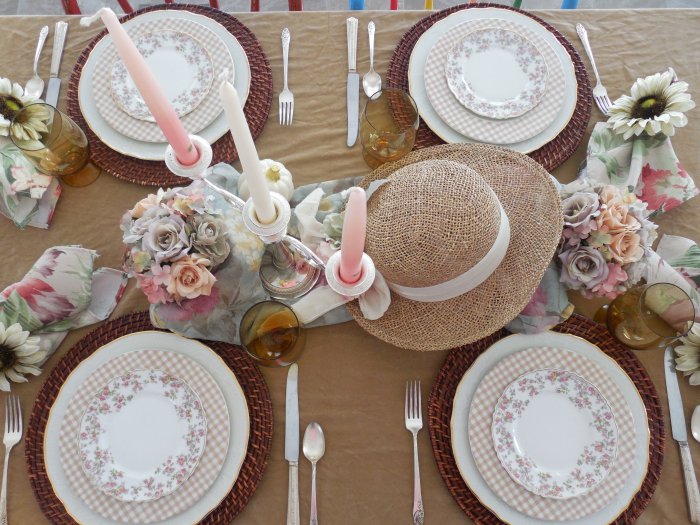
A summer dress, silk bunches from Michael’s, a candleabra and a garden hat are arranged to suggest a stroll through the late-summer garden.

Designing a centerpiece can be one of the most creative aspects of making a tablescape. Have fun gathering a few elements from around the house that support a particular theme or color scheme, and see what you come up with. And when in doubt, remember that flowers – whether fresh or faux – always brighten a table!

Posted in Tablescapes | Leave a comment

Tablescaping 101: how to layer dishes to create a great stack

Welcome back to my blog series, Tablescaping 101! In Part 1 we looked at the correct way to set a basic place setting for both casual and formal dinners. In Part 2 we learned some strategies for planning a tablescape so you don’t find yourself missing key elements when you go to create your design. And, I shared a link to the free Tablescaper’s Checklist to aid in your planning! (Because one time? I set a pretty table for Christmas Day and found that I had given absolutely no thought at all to a centerpiece – yikes!)

Today in Part 3 of the series, we’re going to look at layering dishes – or as I call it, “building the stack.”

Building a pretty stack is easier if you have a bit of a collection to play with, but you can also do it with just a few basic pieces.

The stack is the collection of plates used at each place setting on your table. For me, creating the stack is one of the most creative aspects of tablescaping! It’s one of the things that elevates this activity from simply “setting the table” to the art of “tablescaping.” My enthusiasm for creating the stack is also why I have such a large collection of seemingly random dinnerware: if I come across some fun or pretty or unusual dinner or salad plates at Goodwill and the price is right, I buy them because I trust I already have something on hand at home that will coordinate with them in a great stack!

Here are a few basic guidelines regarding the stack:

  • Your stack pieces can all match.
  • Your stack pieces do not have to match.
  • Your stack should include a plate for each course of the meal.
  • Your stack doesn’t have to include a plate for each course of the meal.
  • You don’t have to have a stack at all!

If you’re catching my drift here, you’re figuring out that there’s a lot of leeway when creating the stack! So let’s dig in!

First and foremost, your stack is going to be based on what food is being served. There’s no point in including a soup bowl at the top of the stack if you’re not serving soup!
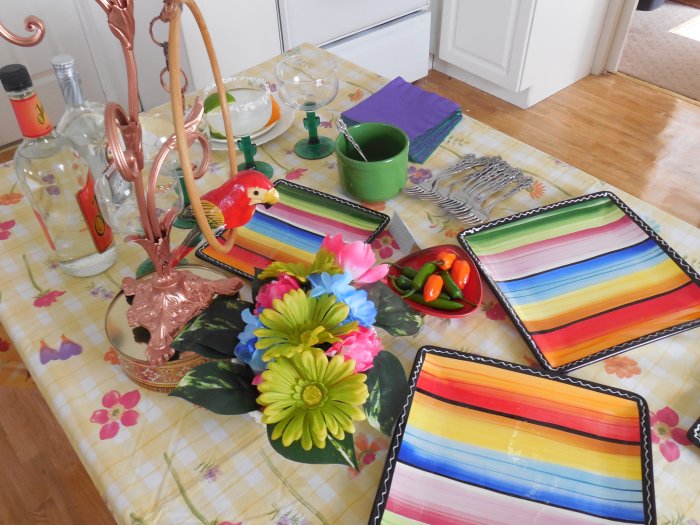
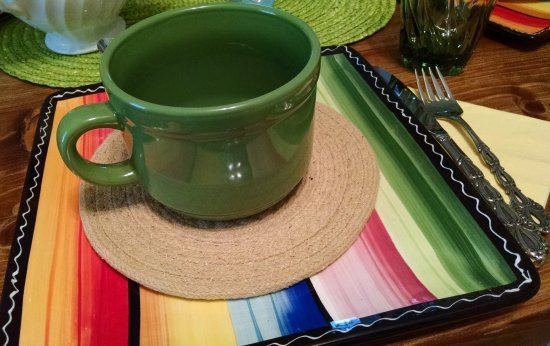
This mug is larger than it looks – it’s actually a soup bowl picked up from Dollar Tree a few years ago. Looked great with the “Serape” dinnerware from International China, and was perfect for a meal of tortilla soup and tacos!

Probably the most common stack for me is comprised of a dinner plate, salad plate, and bread or dessert plate. Although we learned in Part 1 that the bread plate is set to the upper left of the place setting, and that the dessert plate is usually brought in later, I still often include one small plate in my stack for bread because I just love the visual aspect of it. I leave room on the table for each guest to move their bread plate to its proper position after they’ve been seated.
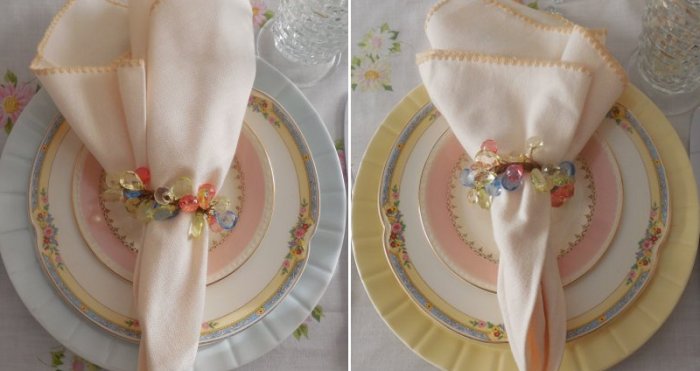
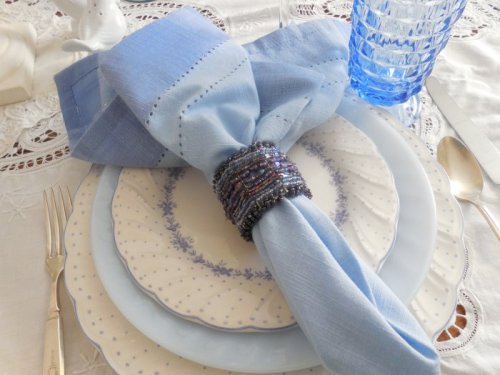
In this stack the dinner and dessert plates match – they’re “Blue Peony” by Nikko. The salad plate in the middle is by Fire King and is an ice-blue hue.
Choosing the pieces for the stack
For the sake of simplicity, let’s learn to create a stack using just two plates: dinner and salad.

If you have a set of formal china, or a set of casual dinnerware where the pieces are at least coordinated in their border design, the easiest way to create a great stack is to simply layer these pieces in their intended fashion. A stack of matched or coordinated dinnerware is guaranteed to be beautiful!

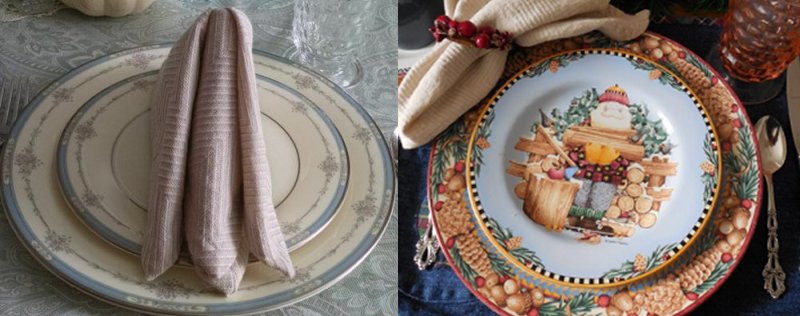
A traditional matching place setting (left: Royal Doulton “Lisa”) or a more casual setting with pre-coordinated edges (right: Debbie Mumm’s “Woodland Santa”) are guaranteed to be beautiful!

Where the creativity of tablescaping comes in is when you try to branch out from these matched or coordinated pieces and start pairing them with something else.

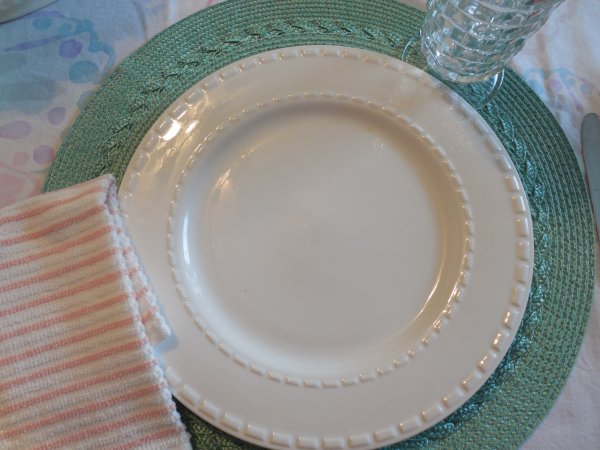
Probably the most versatile set of dinnerware you can own as a tablescaper is plain white. Most of us lead very casual lives these days, so plain white “ironstone” (heavy, durable ceramic) is a great place to start if you are building a tablescaping collection. My plain white casual is this set I bought from Home Goods a few years ago: four dinner plates with that neat stitch-look border.

The “stitch” border is casual, but plain white coordinates with SO many fun and colorful salad plates! I bought this set of 4 dinner plates from Home Goods for $10.

Discount stores such as Big Lots also often have inexpensive plain white sets, and Dollar Tree also usually has plain white plates (as well as some very cute seasonal pieces) in stock.

With a nice set of plain white casual dinnerware, it becomes really easy to start creating fun and interesting stacks with just the addition of salad plates.

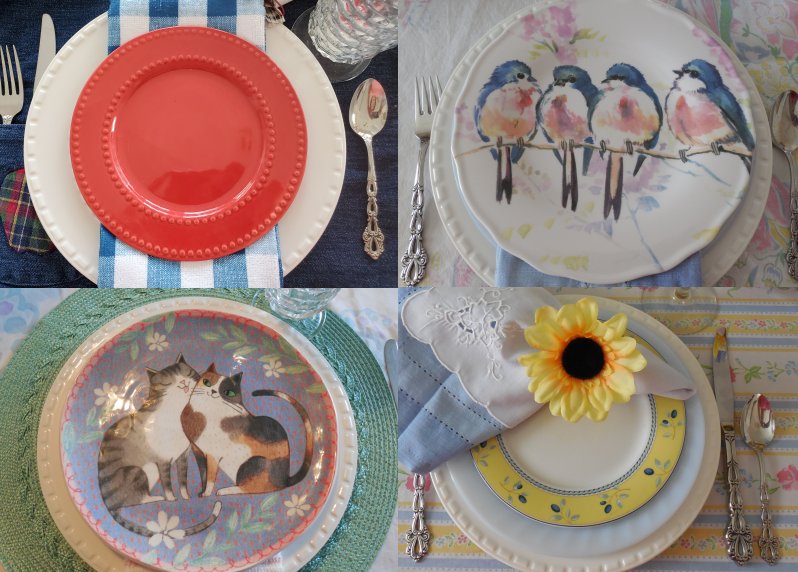
My Home Goods “White Stitch” plates look great with so many different salad plates and salad/dessert combinations!

My favorite sources for finding salad plates (well, all dinnerware really) are secondhand stores of all kinds: Goodwill, charity shops, flea markets, auctions, etc. By the way, you can often get a great bargain on entire sets of fine and casual china at estate auctions.

How to make a great pairing

But, how do you decide which mismatched dinner and salad plates are going to look good together? If you’re just starting out and experimenting, the easiest way is this:

  • Start with one plate in a solid color and the other plate in a pattern.
  • Stack plates of similar “weights” (casual ironstone or “fine china”)
  • Consider whether the borders/edges work well together

Here are some examples to illustrate the above points:

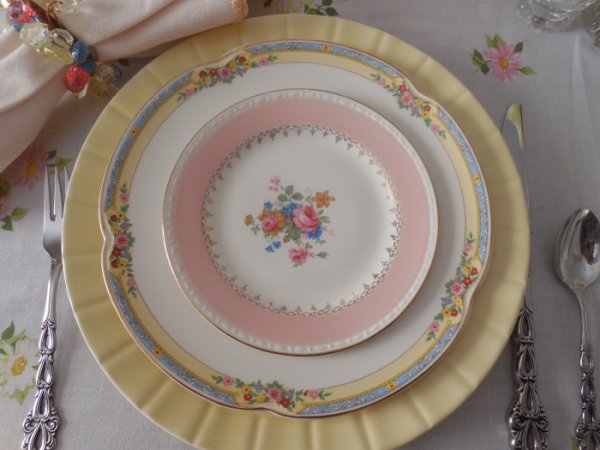
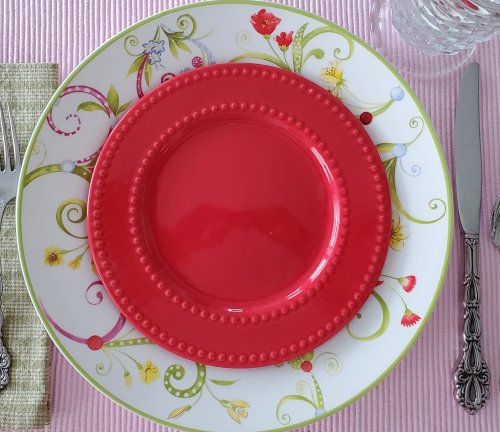
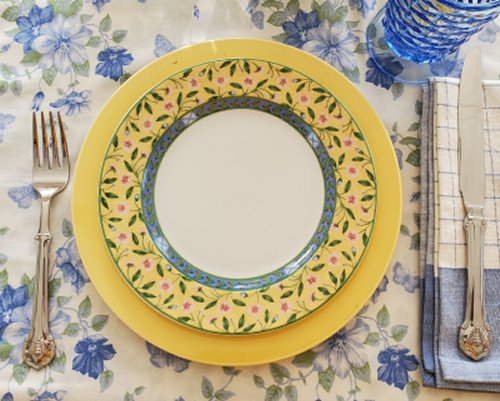
Solid color dinner plate & patterned salad plate with at least one coordinated color.
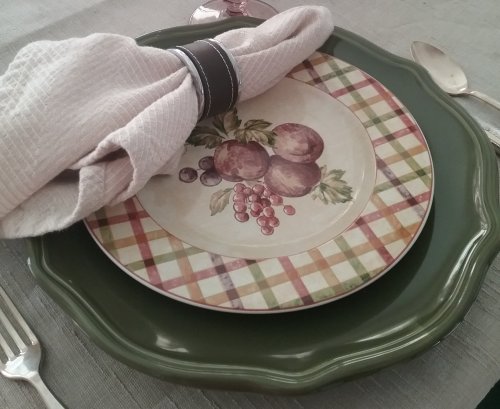
Patterned dinner plate with a solid color salad plate.
Two mismatched plates of a similar “weight” – both are a medium-weight ironstone.
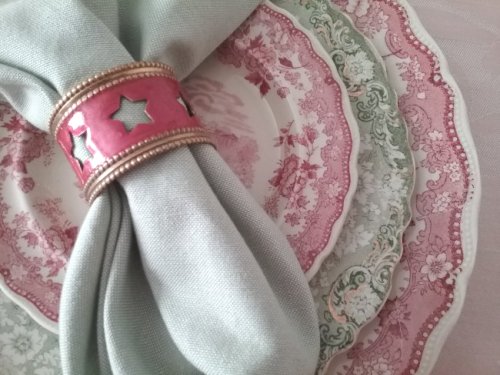
Delicate English transferware in two colors and two patterns – red and green were used for a Christmas luncheon table.
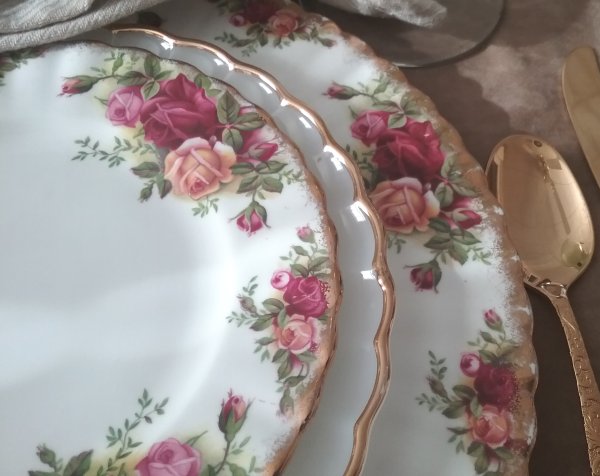
Two completely different types of china can look great together if something about the edges ties them together. Here, English bone china from Royal Albert called Old Country Roses shares some edge similarities with American Fire King in the middle of the stack.
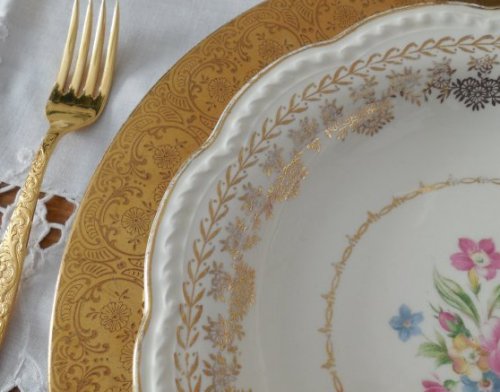
A scalloped edge can look great with a smooth edge, again as long as there is something that ties them together – here, a detailed gleaming gold pattern is the common element.

Once you’ve tried the basics as outlined above a couple of times, try combining a couple (or even three) mis-matched patterns.

This stack works despite the mis-matched small-scale borders.

You can also try mis-matched “weights” of dinnerware:

Delicate Limoges fine bone china can work with heavy “chunky pottery”-type plates.

Chargers and Placemats
You’ll often see a charger used underneath the dinner plate in a more elegant table setting. Chargers are essentially “drip catchers” but they can also anchor your design visually and add style to the table.

The burnished gold charger provided some visual separation between the roses on the dinner plate and the tiny roses of the tablecloth.
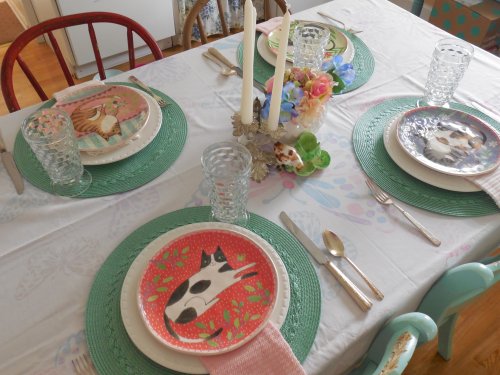
A rattan charger provides texture to help ground dinner, salad and bread plates of completely different styles and weights.

The more informal alternative is of course a placemat which serves the same purpose(s) but is probably far more familiar.

Simple woven straw placemats in a huge variety of colors will catch the drips and add visual “grounding” for plain dinner plates that might get lost against the pattern of a tablecloth.
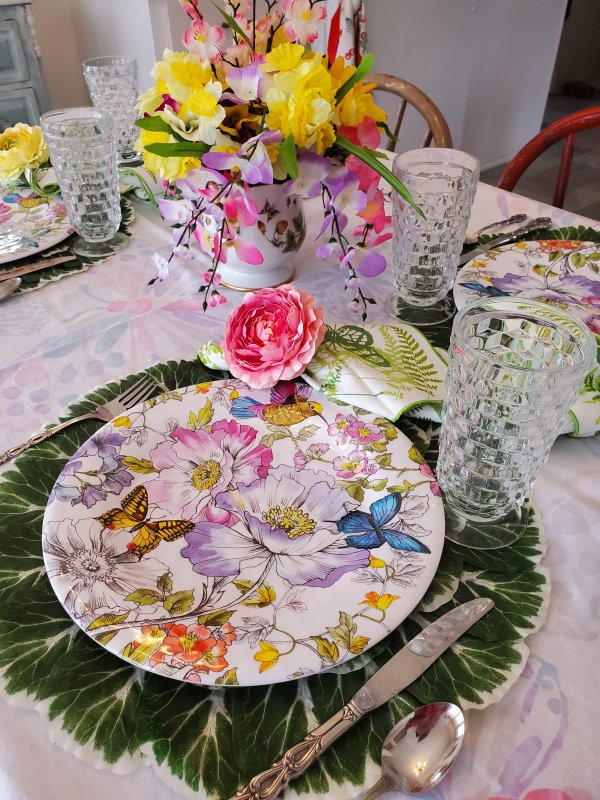
Placemats don’t have to be boring! These “cabbage leaf” mats from Pier 1 made a perfect backdrop for exuberant garden-themed dinner plates.

When using these elements, add visual appeal by making sure they coordinate with the plate stack and/or enhance your theme.

You don’t have to have a large collection of dinnerware, but to fully enjoy the art of tablescaping you’re going to want to collect a few options in both casual and formal styles that will allow you to mix-and-match. Here are my best tips for getting started with great stacks:

  1. Acquire a set of plain white dinnerware to use as your base. It doesn’t have to be expensive!
  2. Shop thrift and other second hand venues for patterned salad plates that will look good with your white pieces. Remember that “salad” plates aren’t just for salad – they can also be used for bread, dessert, or even individual vegetables like large baked potatoes or sweet corn!
  3. While my basic starter method involves usig solid-color dinner plates and patterned salad plates, you can of course reverse that and use patterned dinner plates with solid-color salads.
  4. Take time to play with the dishes! Bring example pieces of all your dinnerware out of the cupboards and just try stacking them to see what looks good together!

Of course, there are many other elements to a great tablescape besides just the dishes. In future installments, we’ll look at glassware, flatware, centerpieces, and others.

Here’s an image to pin on Pinterest if you’d like to save this post for future reference. As always, if you have any tablescaping questions, please feel free to ask in the comments or send me an email to janet@vfcstyle.com !

Posted in Tablescapes | 2 Comments

Tablescaping 101: planning a tablescape

Welcome back to my blog series, “Tablescaping 101!” I hope you enjoyed the first post, Place Setting Basics. In that post, I showed you a few variations on the basic casual and formal place settings, and we talked a little about the importance of a proper table setting.

The most common elements of a formal place setting, properly placed.

Now it’s time to have some fun planning your next tablescape! It doesn’t really matter if you’re planning a table for two or for 20 – the principles are the same. Of course, pulling a couple of plates from the cupboard and putting them down on a placemat doesn’t require much in the way of planning, and that’s okay – there are days when we just don’t have time for anything beyond the basics. (Not to mention days when we’re lucky just to eat from the drive-thru bag!)

This planning guide, though, is for those times when you want to give a little more thought to design, theme, or aesthetic, and create a dining experience that’s just a little more than ordinary!

By the way, my free Tablescaper’s Checklist might be useful, especially for a larger gathering. You can download it here!

Here five tips and a bunch of suggestions for planning your next tablescape!

1. Who, What, Why?
A good plan starts with the number of guests, the reason for the gathering, and an idea of what will be served. Even if these elements do not themselves suggest a theme for your table, you’ll need to keep them in mind as you plan your table design. Be sure you have seating, dinnerware, flatware, glassware, and napkins for everyone. Bonus tip: if you’re like me and you tend to take pictures of your tablescapes, it might also be helpful to refer back to your photos to see what you’ve done in the past!

2. Choose a theme – it helps!
You’ll want some sort of theme to guide your creative efforts. Here are some theme ideas to get you started:

A holiday – Thanksgiving, Christmas, someone’s birthday, or maybe even something just for fun like National Teddy Bear Day. Visit the National Day Calendar website for something special happening most every day, week, or month of the year!

“The Golden Glow of Christmas,” my 2017 Christmas table. More photos here.

A color scheme – classic blue and white, school colors, red white and blue (or any nation’s flag colors), pastels in Spring.

An “inspiration piece” – a favorite tablecloth, vase, or new set of dishes. This could also be a favorite song or movie, or something you incorporate into your centerpiece such as family photos or a small figurine.

A season – Winter, Spring, Summer, Fall, Faded Summer, Back to School… anything you characterize as a season can be a good theme!

“Summer Garden” tablescape from 2018. More photos here.

A locale– Paris, the beach, your hometown, a past or future vacation destination.

The food – a taco bar might suggest a Mexican theme; escargot – a Paris theme; spaghetti – an “Italian Restaurant” theme.

National Margarita Day buffet/margarita bar, 2019. More photos here.


3. Elements of a tablescape

Beyond your theme, now it’s time to think about the actual elements you’ll use, and how many of each you will need. Dinner plates, salad plates, bread plates, dessert plates, soup bowls, water glasses, and wine glasses are the most common elements along with basic flatware. If something you’re serving requires a special utensil, be sure you have enough of them for each guest. These elements should enhance your theme and complement each other.

Also, remember that things don’t have to match to go well together! I shop for dishes primarily in thrift stores and other second-hand venues, where finding a full set of dishes isn’t always possible (or even preferred). Therefore, I often buy things in pairs or sets of four. I’ve been known to choose two similar-but-different patterns in salad plates, or same-pattern-different-colors in a dinner plate, when I didn’t have enough of one pattern or color to go around.

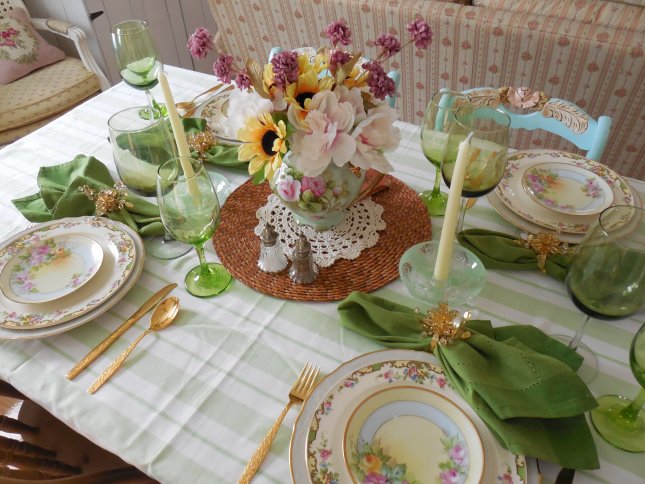
Same pattern, different colors! These dinner plates are both Martha Stewart Everyday – I call it the box pleat pattern. Since I’ve only ever found one-off strays in the thrift stores, I can’t do a full table in one color. This table is just based on a pastel color scheme. More photos here.

4. Plan your centerpiece.

A platter of meat was always the centerpiece at my grandmother’s table, except at Christmas when she would have a beautiful arrangement of red carnations and white pine greenery, courtesy of the FTD floral delivery service. The centerpiece is where I tend to go a little overboard, but sometimes, simple is better: a vase or unusual container full of real or silk flowers is always beautiful! You could also incorporate interesting candlesticks or votive holders, or conversation starters such as thrift store finds, something hand-crafted, or even a garden hat.

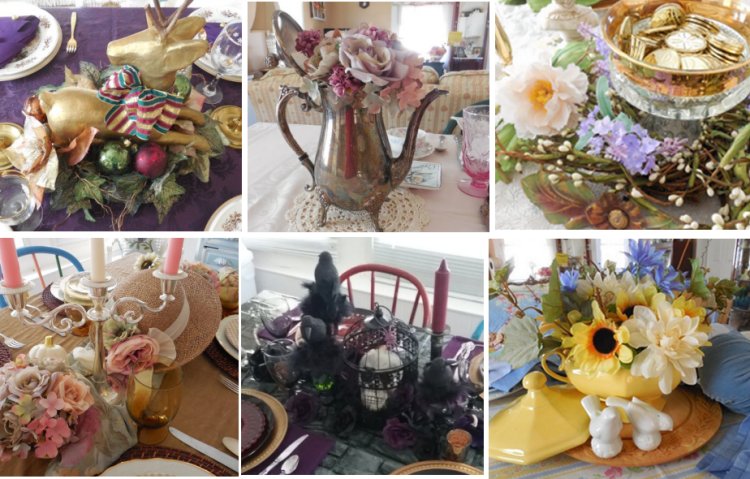
I mean… I really DO get carried away sometimes with my centerpieces. Top row: gold-painted deer with jewel-tone ornaments; tarnished silver teapot with Faded Summer silk flowers; “Pot of gold” and pip-berry wreath. Bottom row: Faded Summer garden stroll; spooky Gothic Halloween table; Provence-inspired tureen with sunflowers.

5. Consider the amount of space you have available.

I once was in awe of an amazing tablescape I saw online using the theme of bees. It was beautiful! So many “bee things,” bee colors, and related decoration. But I quickly realized that with all the stuff on the table dedicated to enhancing the theme, there was no room for food! This seemed like an important lesson, and I resolved then and there that my tables would always leave room for the food. In my present home my only dining space is the eat-in kitchen. My table seats six, but I typically set it for four. There is plenty of room at either end for the serving platters and bowls. I’m also fortunate to have a small sideboard near the table. If you have a sideboard or buffet available, you can utilize that space for platters and serving bowls. Otherwise, you have to plan your tablescape to leave room for the food!

Just like Grandma’s house – plenty of room for platters and serving pieces! More photos here.

Hopefully this brief planning guide will spark your creativity, and the free Tablescaper’s Checklist I mentioned will help keep you organized! Remember, you don’t have to have a special occasion to set a pretty table. A favorite color, your everyday dinnerware, or even just cut flowers from the garden are all great reasons to get creative with your next table setting.

Next up in the Tablescaping 101 series: more about “the stack,” and finding clever ways to mix-and-match your dinnerware!

Here’s an image to use on Pinterest if you’d like to save this post for future reference!

Posted in Tablescapes | Leave a comment

Tablescaping 101: place setting basics

Welcome to my new blog post series, Tablescaping 101! This series will introduce you to – and help you learn to truly enjoy – the practice and art of setting the table!

You might be new to the concept of tablescaping – which really is just a fancy way of saying, “setting the table.” I tend to think of “setting the table” as something very basic, while “tablescaping” elevates it by giving a little more thought to style, design, and aesthetic. But really, whether you’re tablescaping or just setting the table, there is a correct way to arrange the place setting. And I – much to my surprise – found out as recently as a couple of years ago that I was doing it wrong!

Incorrect tablesetting | Vintage Floral Cottage
Would you believe it: I posted this table setting in all its flawed glory… and actually hoped people would come and look at it! HORRORS!

In this post we’ll cover the basics of casual and formal place settings, and consider briefly why it’s important to do them correctly. As you’ll see throughout this series, there’s more than enough room for creativity while still adhering to the basic rules.

To begin, let’s look at the correct placement of elements in a casual place setting.

The basic place setting most people use when sitting down to dinner, at least in the U.S., consists of dinner plate, fork, knife, spoon, napkin, and water glass. These elements are set like this:

This setting is so basic, it’s printed on placemats for children so they can be trained to set the table. What’s that old saying – ‘Practice makes perfect’!

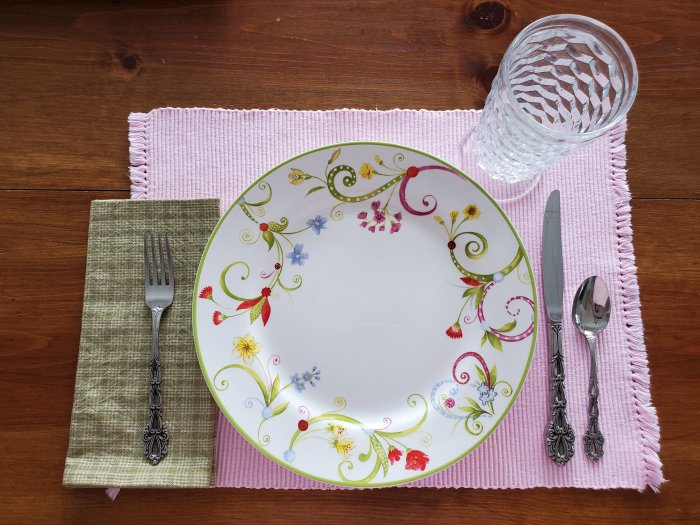
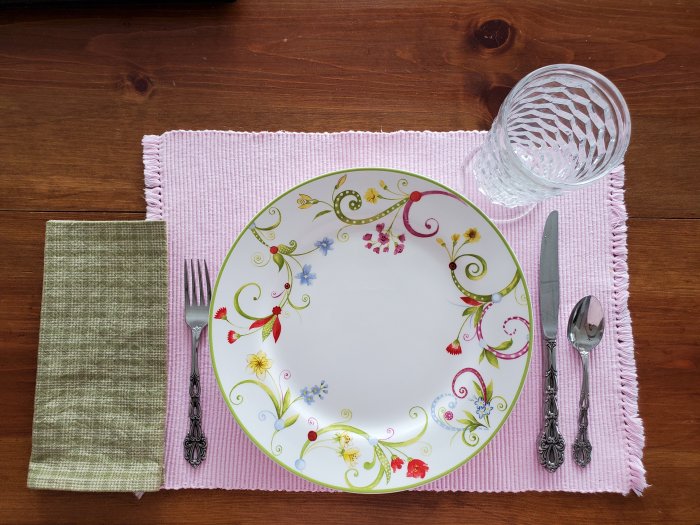
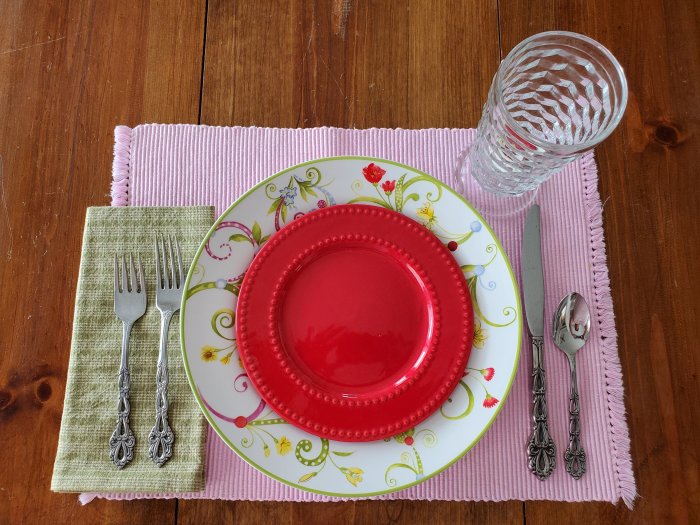
Working from the left, we have the napkin & dinner fork, dinner plate, dinner knife, and teaspoon, with the water glass set to the upper right of the dinner plate.

There’s actually some dissent about the napkin placement: some people set it to the left of the fork instead of under it, some set it on the plate.

Basic place setting with the napkin to left of the fork. Proponents of this option point out that it saves guests from having to move the fork to get to the napkin.
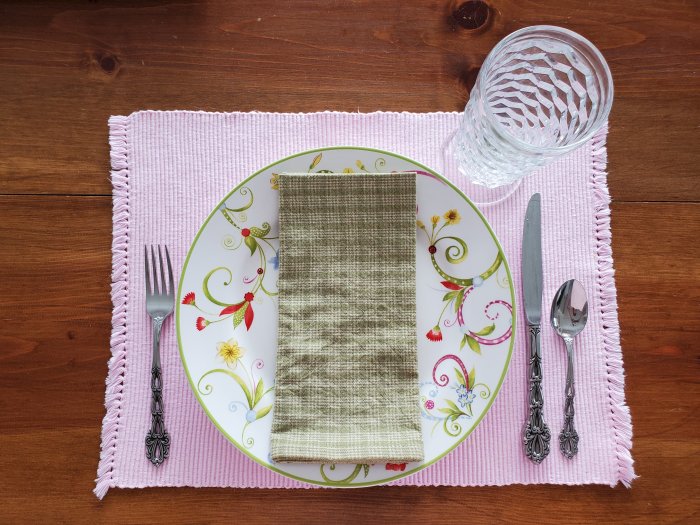
Basic place setting with the napkin settled on the plate. Dissenters of this method say you don’t want leftover detergent from the napkin inadvertently flavoring the food. Still, it’s the most compact option.

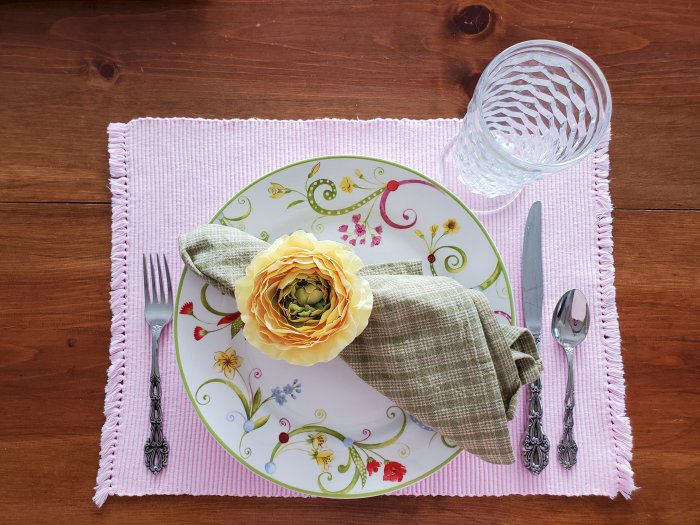
Another option is to move the napkin to the right: in virtually every table I’ve set where the napkin is folded flat like this, I’ve set it under the right-side utensils. But my favorite way is to give the basic setting just a smidge more personality by setting the napkin on the plate or off to the upper left, inside a napkin ring!

Basic table setting | Vintage Floral Cottage
It’s just prettier this way, and immediately makes even a simple setting look just the teensiest bit ‘styled’!

Taking a step beyond this basic setting, if you were to add a salad course to the meal, you would simply need to add the plate and the salad fork. The salad fork is set to the left of the dinner fork, and the salad plate can be placed on top of the dinner plate. If you ever sit down at someone else’s table and wonder which fork to use, remember: with flatware, work from the outside in!

The salad fork is shorter than the dinner fork, and might have one additional tine. If we were to add soup to this meal, the soup bowl would be placed on top of the salad plate and the soup spoon would go to the right of the teaspoon.

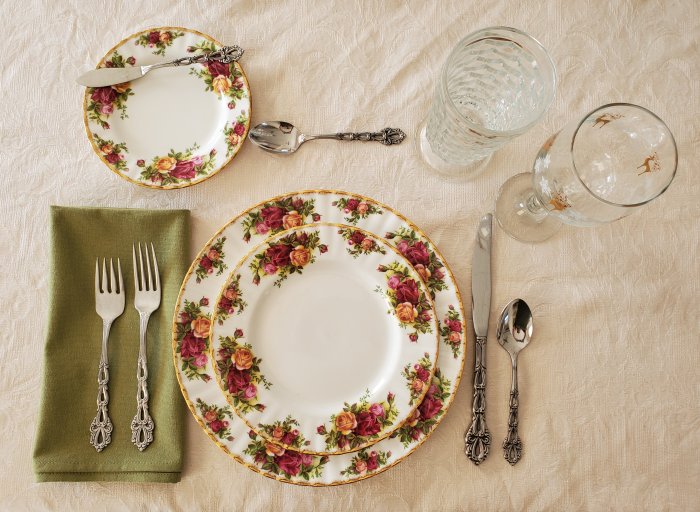
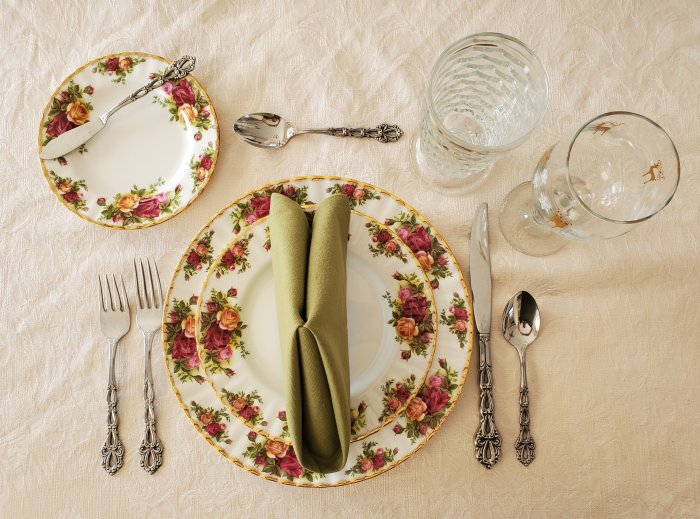
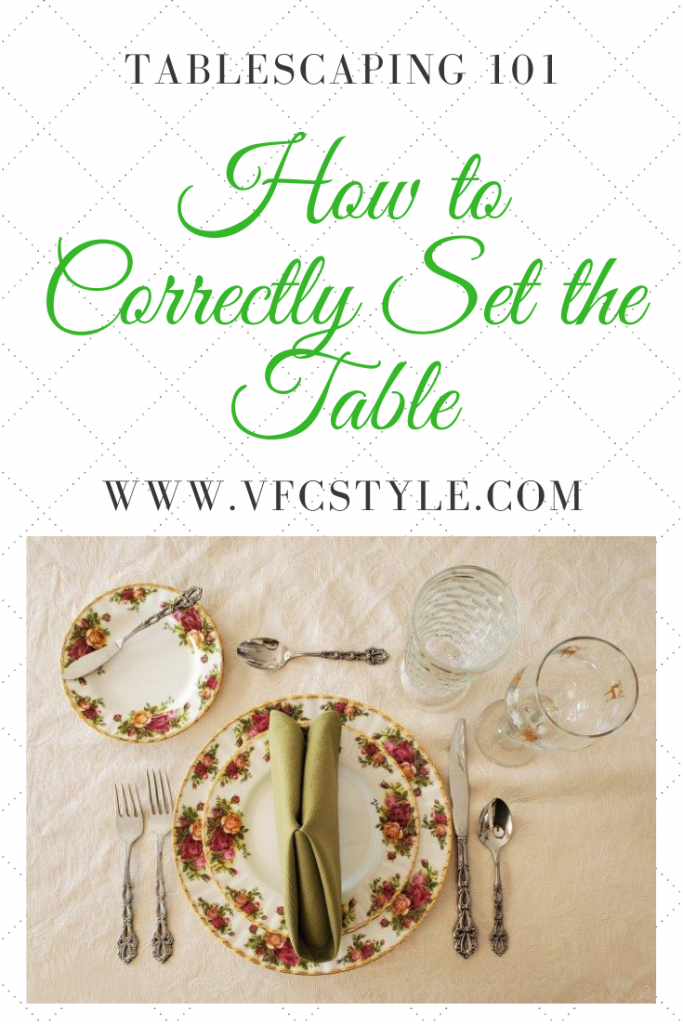
It’s actually a very short hop from casual to formal. Here’s a basic formal setting that includes a few more pieces: a bread plate and butter knife to the upper left of the dinner plate, a wine glass to the right of the water glass, and a dessert spoon across the top of the plate.

Here’s the same setting with a couple of napkin options:

These are the basics of setting a table properly, working our way from a casual setting to a more formal multi-course style.

Wandering napkins aside, I think it’s always worthwhile to take a moment to set the table correctly, even at the most basic level.

Why? As with so many other things in life, standardization is good because it brings order to potential chaos. Imagine if time pieces weren’t standardized: everyone’s clocks would have the same numbers on them, but sunrise at Ted’s house might be at 6:30 while at Bob’s it could be at 10:25. They’d never get that squash game going!

Furthermore, with order comes comfort – or at least familiarity. Your guests have been taught to use the forks “from the outside in,” so why make them fumble for the right utensil at your house?

Finally, setting the table correctly each time – and therefore creating order and familiarity – ensures that guests will be able to focus their attention on engaging in conversation, building relationships, and actually enjoying the food and the fellowship of the meal, rather than worrying over whether they’re using the right fork. A proper table setting conveys respect to your guests (or family members) and shows them that you want them to be comfortable and to enjoy themselves.

Taking time to set the table is a great way to involve the kids in meal time, by the way. Even pre-schoolers can help set items on the table, and can easily learn the correct way to do things. It may surprise you to know that I also encourage you to let your children handle the “good china,” because proper reverence for breakables and valuable things is an important trait to instill.

Next up in the Tablescaping 101 series: tips for planning your next tablescape!

Here’s an image to use on Pinterest if you’d like to save this post for future reference!

Tablescaping 101, Table Setting Basics | Vintage Floral Cottage
Posted in Tablescapes | Leave a comment