It’s National Thrift Shop Day, an opportunity to recognize and support the contributions that thrift stores and other secondhand retail venues make to our individual lives and our local communities. I am not going to have the opportunity to actually shop today, so I thought I would celebrate with a blog post showcasing the many elements of my home that have been made possible through thrift stores.
While there is indeed a short list of things I won’t buy from thrift stores, it’s fair to say that about 95 percent of my clothing, home decor, and furnishings (and of course my larger-than-normal tablescaping stash) come from thrift stores.
Here are a few views around the house that simply would not reflect my actual personal style if most of the elements had not been thrifted:
Living room view. The only things not thrifted/secondhand are the television and the slipcover on the sofa.
The view upon entering the house. Not thrifted: the white stepback cabinet, hand-built by my sweetie.
Eat-in kitchen view. Not thrifted: the microwave.
Three-season front porch view. Everything thrifted/secondhand.
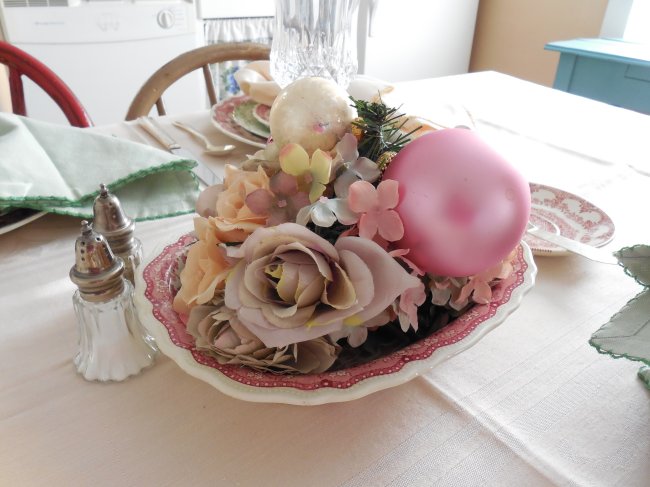
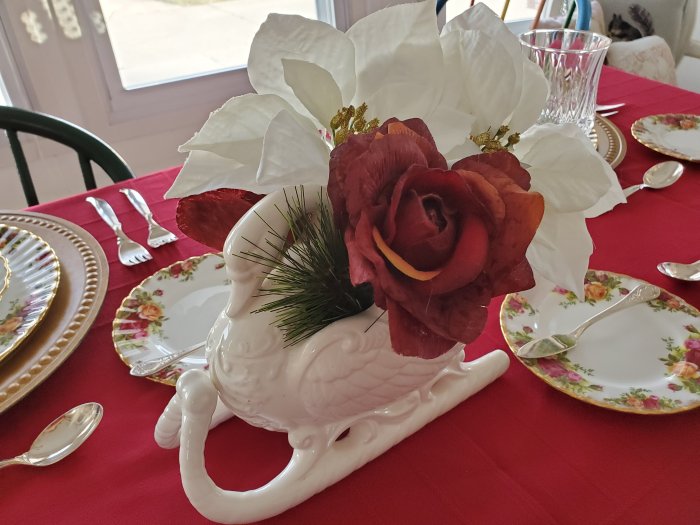
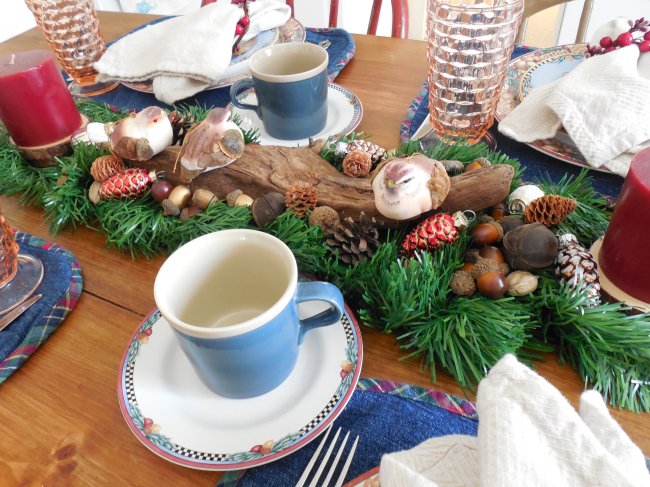
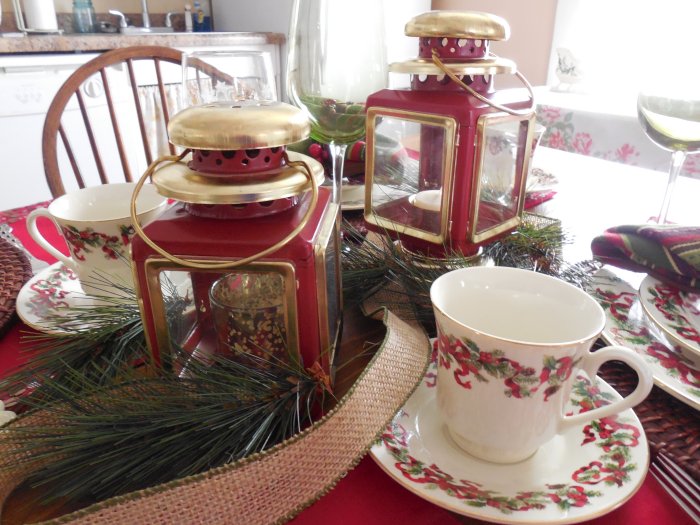
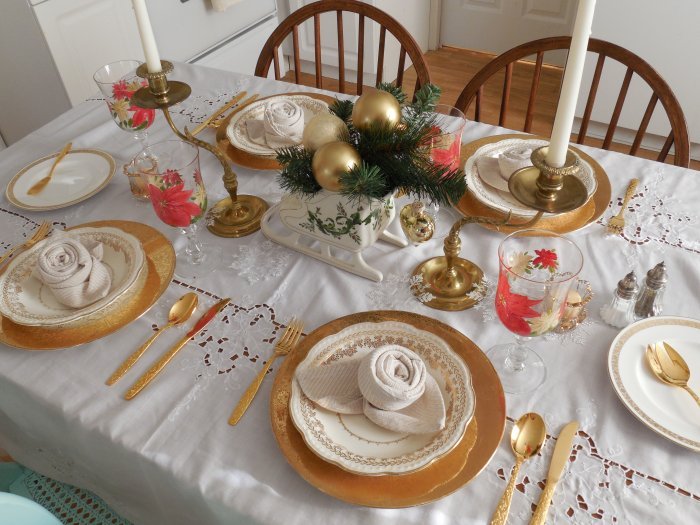
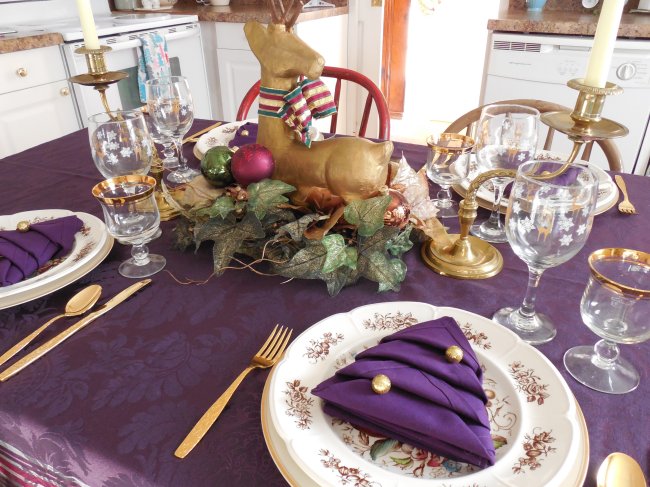
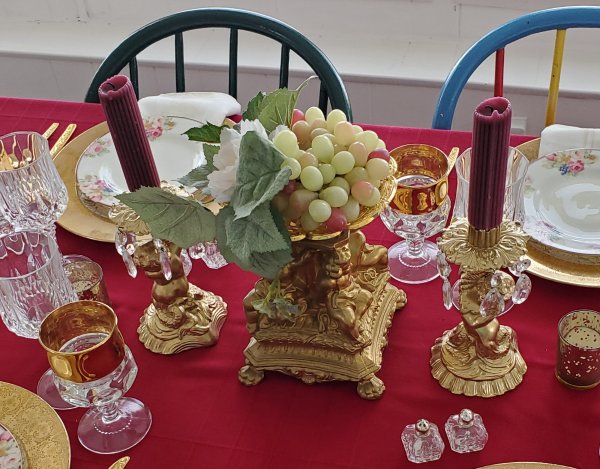
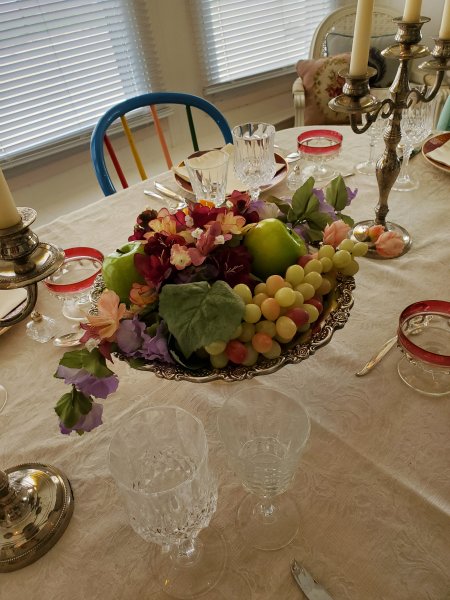
Of course, most of my tablescaping stash is thrifted too. Here are just a few tables I’ve set in the last few years comprised almost entirely of items found in thrift stores and secondhand venues.
Spring tablescape! Not thrifted, the white dinner plates (Home Goods) and the flatware, an Amazon splurge called Napoleon Bee by Wallace (affiliate link – I earn a small commission if you purchase through my link, but it costs you nothing extra).
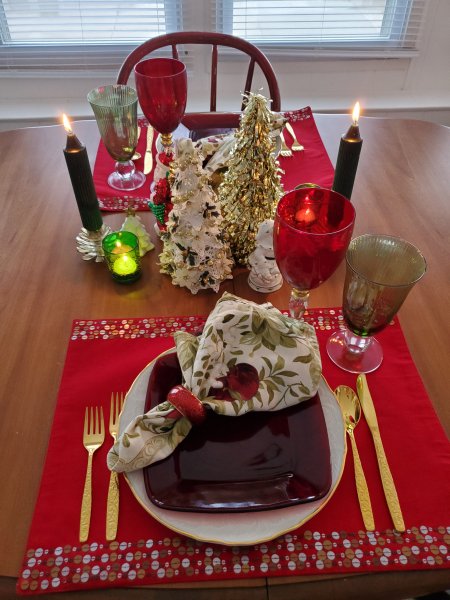
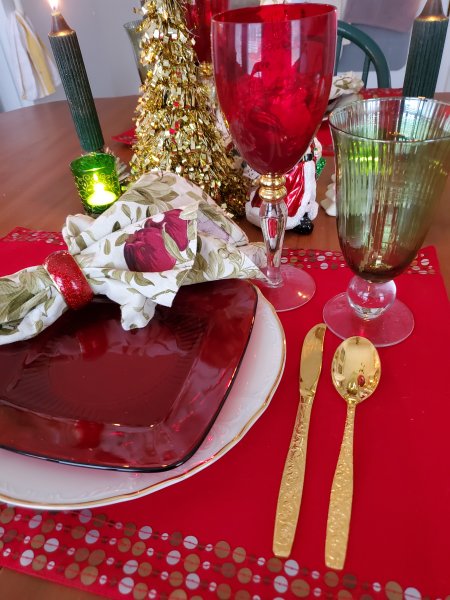
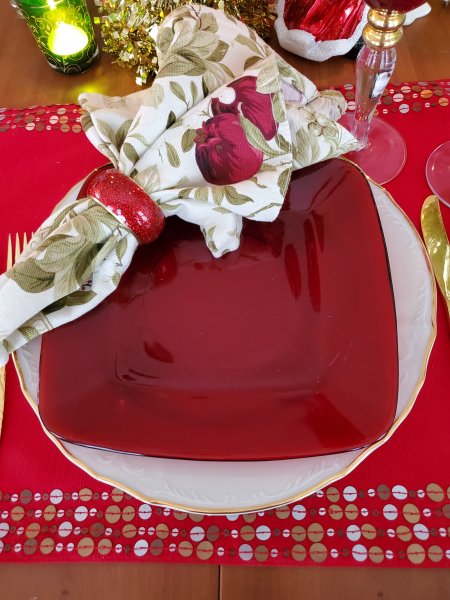
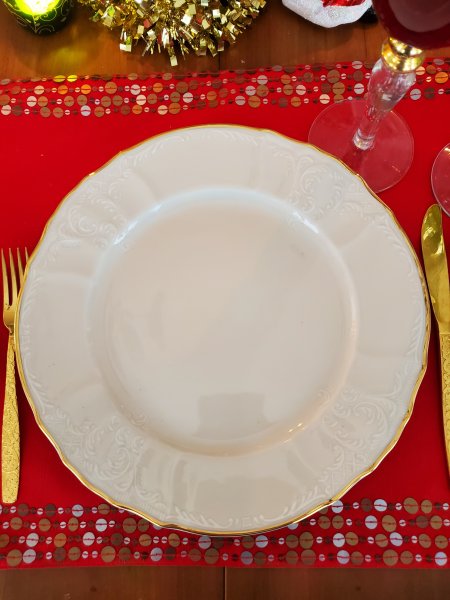
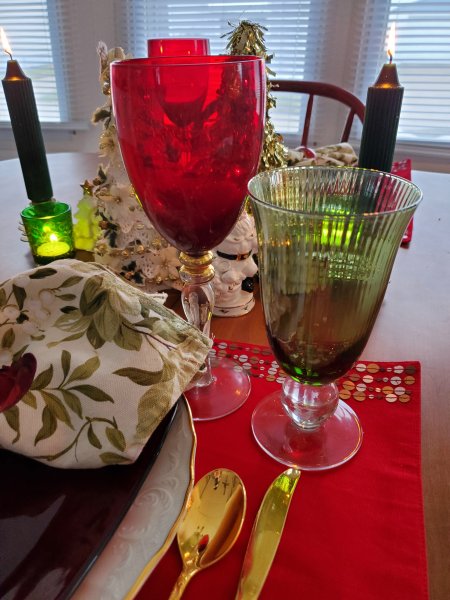
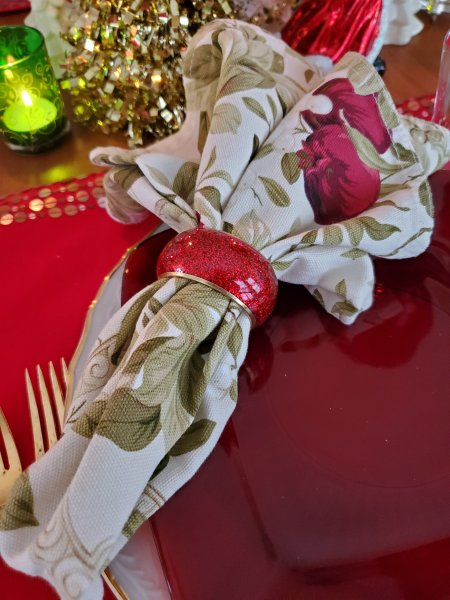
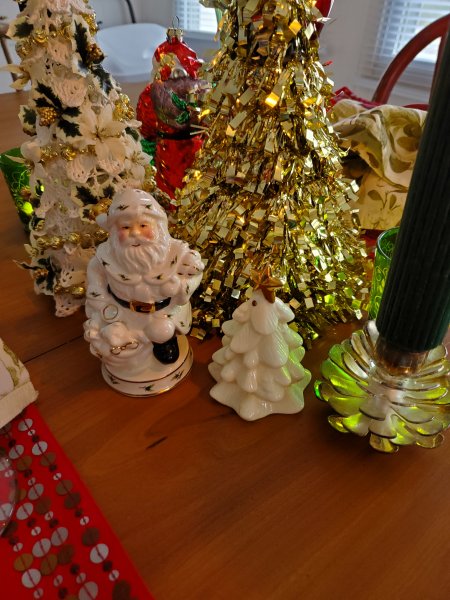
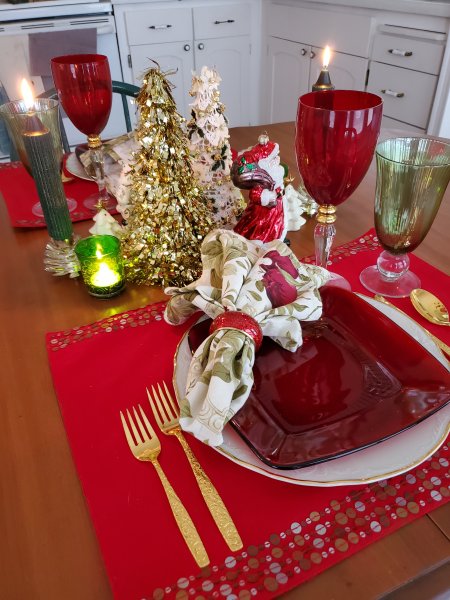
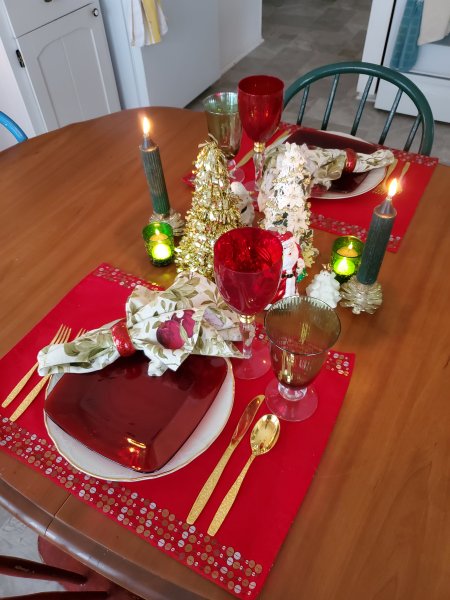
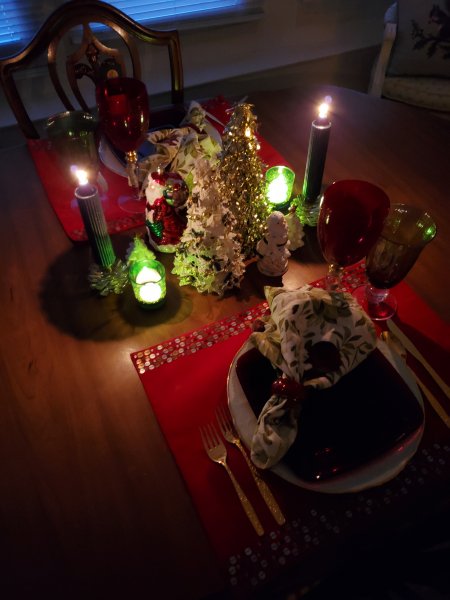
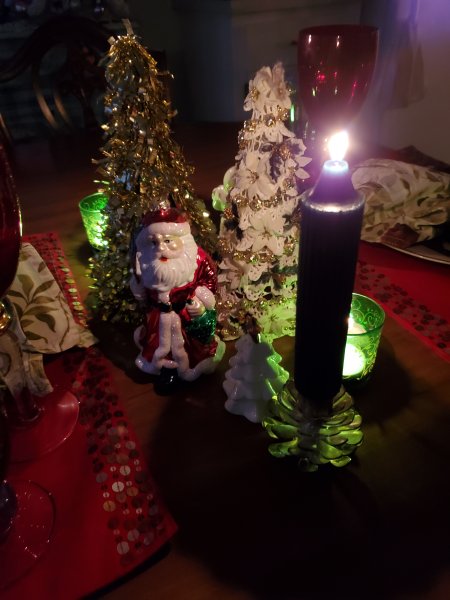
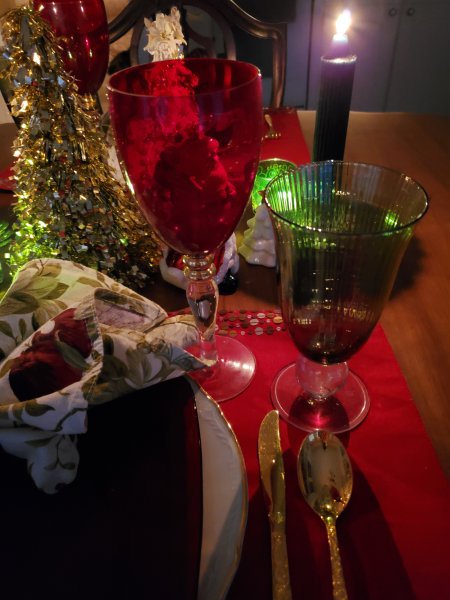
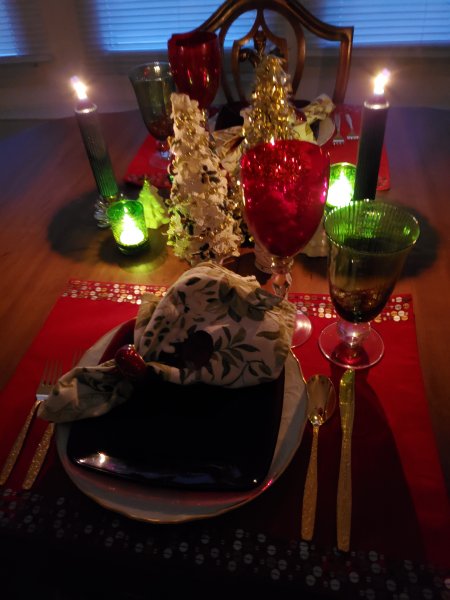
Christmas tablescape. Not thrifted/secondhand: the green stemware (Dollar Tree) and the sparkly placemats (a gift).
Princess-themed tablescape. Not thrifted/secondhand: The chargers, an Amazon splurge.
Christmass tablescape. Everything thrifted.
Blue and yellow Summer tablescape. Not thrifted/secondhand: the blue stemware (Dollar Tree) and the white dinner plates (Home Goods clearance).
Fairytale tablescape. Not thrifted: the Allgala chargers (an Amazon splurge) and the flatware (also from Amazon). Both links are affiliate links. I earn a small commission if you purchase, but you pay nothing extra.
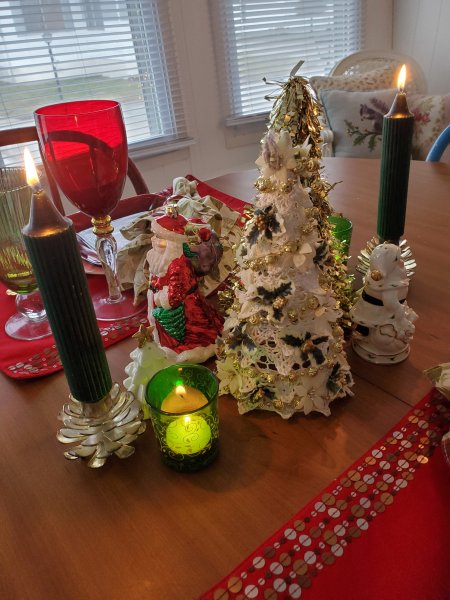
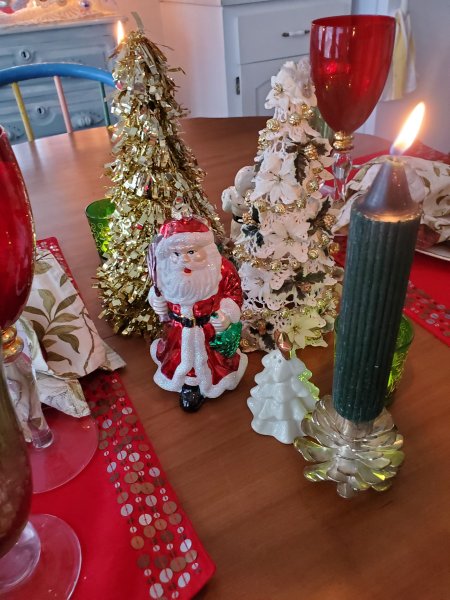
Christmas tablescape. Everything thrifted.
Now I’m not saying that any of these pictures – room arrangements, furniture choices, or even tablesettings – are to be considered perfection. I’m just offering them as examples of how I’ve been able to achieve looks that I personally love because of the existence of thrift stores.
Secondhand shopping can be downright thrilling – magical! – if you take the time to hunt for and cultivate your own personal style. And that is perfection!
Also in celebration of National Thrift Shop Day, I thought I would share a list of my personal favorite local and regional thrift shops and secondhand venues:
Goodwill of Central Iowa Many Hands Thrift Market Stuff, Etc. consignment store The Brass Armadillo Antique Mall The Picker Knows Antique Mall Memory Lane Antiques Antiques Iowa Antique Mall Habitat for Humanity Re-Store Hartmann Auctions What Cheer, Iowa Flea Market Sparks, Kansas Flea Market
And a few other local options that I don’t get to as often as I’d like:
Salvation Army Thrift Store Animal Lifeline Thrift Store The Giving Tree Thrift Store Changing Spaces Consignment Collectamania Antiques and Collectables Iowa State Fairgrounds Flea Market Hope Ministries Thrift Store St. Vincent de Paul Thrift Store Disabled American Veterans (DAV) Thrift Store A-Okay Antiques
Feel free to leave a comment with your local favorites!
I think the biggest challenge in specifically creating a Faded Summer tablescape is to not forget about the word “faded.” For me, a summer tablescape could be based on a garden, a beach, a visit to Disney World, or any summer activity. And of course, it’s still summer so those themes definitely still apply.
But while it is still summer, over here it’s technically Faded Summer (for more about that, click here to pop in your email address and grab your free PDF version of the official guide to the unofficial fifth season!). To me that’s definitely garden-related because the color palette comes from the colors of fading flowers. And it’s not always simple to capture those colors in dinnerware, especially if you’re like me and rely on the whims of finding things in the thrift stores to build your tablescaping collection.
This year’s Faded Summer tablescape does a particularly good job of capturing the colors and textures of the unofficial fifth season. It still looks like summer, but a faded or more muted version of those summer colors.
Each place setting is grounded by a green-checked placemat in muted “botancial” green, and textured rattan chargers in deep brown.
I love using this antique Limoges pattern by Haviland in a Faded Summer tablescape because the pattern is pretty and gardeny but not too brightly-colored. It’s called “Trellis.” The dessert plate looks lovely over the “faded green” pottery salad plate, with the heavy-textured faded pink-check napkin underneath. The plain taupe dinnerplate makes a great backdrop not just for the rest of the plate stack but also for the food that will soon be placed upon it.
Oh those lovely edges and textures!
Our flatware is “Napoleon Bee” by Wallace. (<– This is an affiliate link – I earn a small commission if you click through to Amazon to order yours, but it costs you nothing extra!)
Our glassware/tumbler is vintage “Metropolitan” by Libbey in a perfectly muted plum tone. I adore this color for Faded Summer – it’s even echoed in the floral colors of the centerpiece.
Speaking of the centerpiece, you can see I didn’t go overboard with that this year (like I might have in years past) but of course it uses silk flowers in the deepening hues of Faded Summer as well. They’re collected into a textured woven basket – almost Fall but not quite!
Here are a couple more views. I placed a dessert fork in the upper left of each place setting but I didn’t get a close-up picture of it. It’s my gorgeous handed-down “Chandelier” by Oneida. It will of course be used with the Haviland Trellis dessert plate, which as a guest you would remove off to the upper left of the place setting just prior to picking up your napkin.
And that’s it – a simple, lovely Faded Summer tablescape that provides a visual “rest” between the tropical colors of Summer and the bold colors of Autumn. I love doing these put-away shots – they show how well everything coordinates together, just before it all goes back into the cupboards.
Here’s an image to Pin if you’d like to save this year’s Faded Summer tablescape for future ideas.
I will be sharing my Faded Summer Tablescape for Tablescape Thursday over at Susan’s lovely blog, Between Naps on the Porch. Be sure to click through for more tablescaping ideas!
After reading this post you are going to end up agreeing with me on something you never knew you believed… or getting one of your own beliefs validated (as if you needed that!)… or simply deciding I’m just a little bit weird. And truth be told, I’m okay with any of those outcomes!
It’s simply this: there is stunning beauty in faded flowers!

Not that long ago, I owned a motorcycle. I learned to ride the year I turned 40, and rode for about 15 years. I explored a lot of my beautiful home state and even a little bit outside of it.
Rebel Biker Mom, contemplating crossing the line!
I learned that as a rider, you have to be acutely aware of your surroundings at all times. This means observing details you might miss or even dismiss in a car, because the consequences can be so much more severe if you aren’t paying attention.
Leading the way around gorgeous curves, but always looking for deer and distracted drivers.
In riding defensively and looking for details, I also learned to notice the beauty of a landscape. Sure, a lot of it was farm fields, but in fact they are all different: various shades of green depending on specific crops, different textures depending on the time of year, different compositions of land and buildings.
Lush green Iowa farmland
A chunk of managed prairie after a controlled burn.
In short, riding taught me to notice and appreciate the details all around me, and this soon carried over into home – and garden – life. Because of those experiences, I’m able to notice and appreciate the details found in nature to a degree I simply couldn’t – or didn’t – before. This led me fairly quickly to the realization:
Flowers are stunning in all phases!
Yes, even the wilty ones. Sometimes, especially the wilty ones. This is the picture – and the bloom – that first convinced me of the incredible beauty of fading flowers.
The sunflower itself had been dyed, I assume by the florist who had provided a series of arrangements for an event I was managing. As the flower wilted and the dye leached out into the water, the most incredible color variations began to occur in the petals.
Upon studying the flowers in my own garden, I realized: flowers don’t have to be dyed for this magic to happen – left to their own natural devices, many kinds of flowers go through a phase of fading, changing hues as they age.
I daresay, if you study fading flowers long enough, you’d be hard-pressed not to arrive at the same conclusion: flowers are stunning in all phases! Think about it:
A seed is a wonder. A seedling is a miracle. A young plant is a promise. A flower bud is anticipation. A bloom is a gift. A fading bloom is a treasure. A seed pod is a marvel. And a seed is a wonder!
What I’ve come to realize is that none of those things are less beautiful than the others. Every stage is filled with beauty (and purpose, and beauty in its purpose) if we train our brains to see it.
Shades of brown? Yes please!
But how do we thus train our brains? Here are some of my favorite ways to sharpen my observation skills – and therefore, my level of appreciation for faded flowers:
Let them be! Locate a small patch of something in the garden, and just let it stand as the flowers fade and the seed pods form. (Many plants, such as echinacea, even bring architectural interest to the garden in the dead of winter – not to mention providing a home for beneficial insects – if the stalks and seed heads are left standing.) Pause to really look at the plant at various times in all its stages.
Blanket Flower going to seed.
Sunflower seed head – picked, dried, and harvested.
Take a picture! In your own garden or while taking a walk, take a picture when you notice something that catches your eye in a fading bloom. You don’t have to get particularly “artsy” about this – just use your camera or phone and try to get a nice clean shot of the bloom itself. Better yet, dead-head some of your flowers and just toss the clippings into a pile. Snap an overhead picture – you won’t believe the range of colors and textures! Some of my favorite garden photos are of dead-head piles and blooms that are well past their prime.
Dead-headed detritus – geranium, coneflower, daisy, and more. There was nothing difficult about this photo – I just pointed my phone camera down into the pile and clicked.
Zinnia seeds attached to faded petals.
Seed heads and seed pods from cornflower, cleome, and others.
Allow cut flowers to dry! Roses dry beautifully when hung upside down, as does lavender. (Bonus: potpourri and scented sachets!) If cut at the proper time, hydrangeas can be allowed to sit in a vase until the water evaporates, then the petals turn papery and all sorts of variegated colors. Many other flowers look stunning when dried as well.
Drying sunflowers and roses.
Incredible color variety in a drying hydrangea. This bloom started out as a bright pink!
What I’m trying to say in my typical round-about way (I could write 10,000 words on this topic!) is this: taking time to notice the fading blooms is one of the cornerstones of enjoying Faded Summer. And it’s so easy to take a moment now and then to just stop and appreciate a fading bloom for just what it is: a flower on its way to creating seeds and perpetuating itself.
My wish for you is that you’ll soon be the weirdo out there taking pictures of dead flowers! 🙂
Every cottage needs a cat. For 16 years, this sweet, tiny patch-tabby named Lily has been my cottage cat – and my constant companion. She’s the first cat I ever had that actually responded when called by name, or would come to me when I called her even if I wasn’t shaking the treat can.
She was so vocal it was easy to catch her in what I called “mid-sentence” – I have several pictures of her meowing and they always make me laugh.
She’s also the only cat I ever saw do what Garfield used to call the nap attack: plant face-down into a comforter or pillow and just… be asleep.
She could curl up into a ball less than 12 inches in diameter, or sprawl out with one foot outstretched in command of her chosen surface.
Her true age is unknown. We adopted her from a neighbor in 2008, when she was at least a year old. Within a week of coming to our house, she went into kidney failure. The neighbor and I split the cost of a very basic treatment based on a guess that it was stress-related. She survived and went on to live 15 more healthy, happy, spoiled years.
She moved with me when I divorced in 2014, first to an apartment, then to “the dollhouse” and later to the mobile home, Lynnwood Cottage. When I began working full-time from home in March, 2020, the cottage cat became my immediate supervisor.
She disliked having her picture taken and always seemed to know if that’s what you were up to. She’d put her ears just slightly back in a look of annoyance.
She loved to be petted, but hated to be picked up or carried around. She loved treats, licks of butter, and tiny bites of cheese. If I was walking from one end of the house to the other she’d try to lead the way, but always just a little too slow and always looking back over her shoulder to see if I had “turned off” into the office or bathroom – leading without knowing exactly where she was going.
Lily crossed the rainbow bridge on August 11, 2023, approximately age 16. Losing a pet is hard, but having a pet like her for so long was a joy. I miss you already, Poopers.
For the next few weeks I’m sharing some tips with my email subscribers about how to enjoy the unofficial fifth season, Faded Summer. I’ll also be sharing that info here on the blog, but it’s about a week behind. If you would like to join the list and get the info “hot off the press” (what is the internet equivalent of “hot off the press?”), and get other updates from the blog, just click over in the right-hand column or right here to sign up for your free Guide to Faded Summer – that will get you on the list for future emails!
Last week in the list we covered one of the absolute musts of Faded Summer – noticing and adopting the season’s distinct color palette. And I’m not referring to the colors of Fall, because Faded Summer is actually that in-between phase where summer flowers are fading but we aren’t quite ready for full-on Autumn. Rather, Faded Summer colors are distinctly their own!
When I was creating that free guide (because what new idea DOESN’T need its own free guide, right??), I started sorting through my many photos of “fading flowers” and used a color palette app to pull the dominant colors from several of them. I stitched those together (poorly, because I’m not a graphic artist), and came up with the ribbon shown above – the color palette of Faded Summer.
I think you can see it’s much different from the bold colors of autumn! It’s more the colors of flowers as they fade – when they’re not quite as bright as they are at their peak, but quieter and more muted.
When talking about Faded Summer, I always like to say that it’s needed as a “fifth season” because – well, kind of like the garden in late summer, we’re tired. And hot. And tired of being hot. And we need (deserve!) a bridge between the bright, tropical colors we tend to see and share in summer – and the bold colors of Fall that lead us into the onslaught of fourth quarter holidays and activities.
A visual “rest,” if you will, to create a transition from Summer to Fall that doesn’t feel like we’re on a runaway freight train hurtling straight into Christmas.
Of course, these colors find their way into our little universe in so many ways: clothing, home decor, cut flowers, and others. I do certainly encourage you to look forward to all the Fall and Winter activities yet to come, but also to take a few minutes seeking out and appreciating Faded Summer colors.
Maybe even adopt some of those colors into your decor or wardrobe!