I was recently researching the use of Victorian cruet or caster sets, and a bit of a stray question floated through my mind: are there any famous or at least memorable paintings depicting a dining table? Pictures that give us a peek into the world of period dining, either among friends or with family?
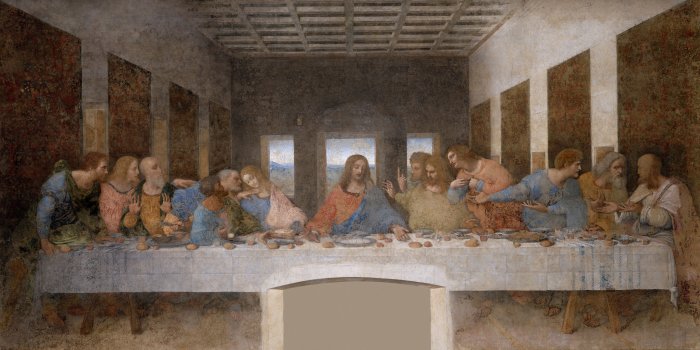
Of course there’s that most famous meal of all, depicted as The Last Supper by Leonardo da Vinci, circa 1495:
Alas, not a cruet set in sight. But seriously, as important this painting is, I wanted to fast forward a few hundred years and delve into the era of Impressionism, roughly 1860-1890, which speaks to me because I’ve been fortunate to have seen several original paintings in person from that time period. Of course, not all paintings of this period were Impressionist pictures – in fact, “Impressionism” was at first panned by the art establishment of the era. But the movement influenced many artists, even if their individual styles were not technically in that realm.
Impressionist or not, here are a few favorites uncovered in my search!
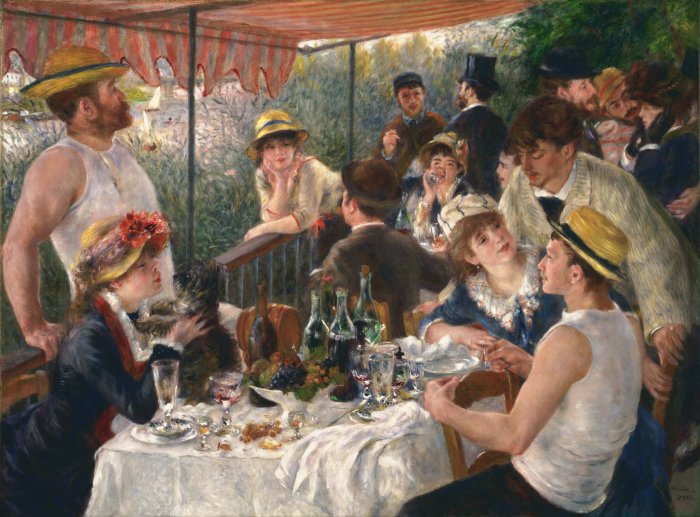
Up first, Pierre August-Renoir’s Luncheon of the Boating Party, 1881. Renoir is one of the most enduring of the Impressionist painters, and one of the original members of that movement. You might be familiar with Two Sisters (On the Terrace) or A Girl with a Watering Can. My personal favorite is La Loge (The Theater Box). But for a glimpse at casual period dining, it’s hard to surpass Luncheon of the Boating Party. The picture features a group of friends (in reality, Renoir’s own artistic friends) having a meal on a terrace (perhaps a boat deck?), and depicts a dining table laden with wine, glassware, and fruit. And a dog’s butt, because little dogs are as French as it gets!
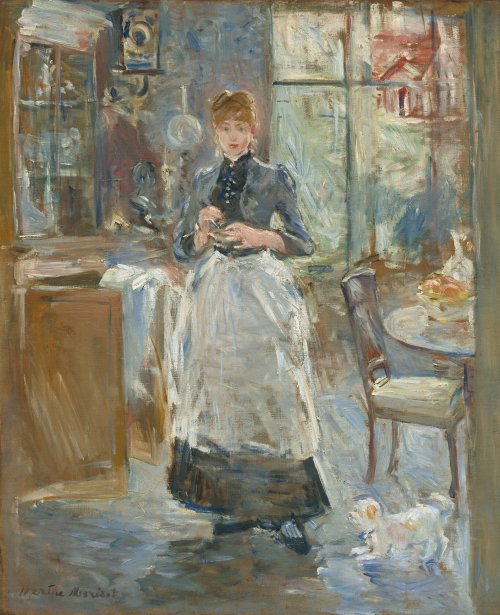
Along with Renoir, Claud Monet, and a few others, Berthe Morisot was one of the original members of the Impressionist movement. She was already an experienced working artist, having shown her work at several previous traditional Paris salons (art exhibitions) working in watercolor. But by 1874 her style had become more aligned with the Impressionists. She endured as one of the better known artists of that movement, and in 1866 she exhibited In the Dining Room at an Impressionist salon. While this picture doesn’t emphasize the table itself, it has a wonderful domestic feel to it that is typical of Morisot’s work, and I love it because it gives kind of an “upstairs/downstairs” vibe. The little dog at her feet and the objects on the table are also wonderful details.
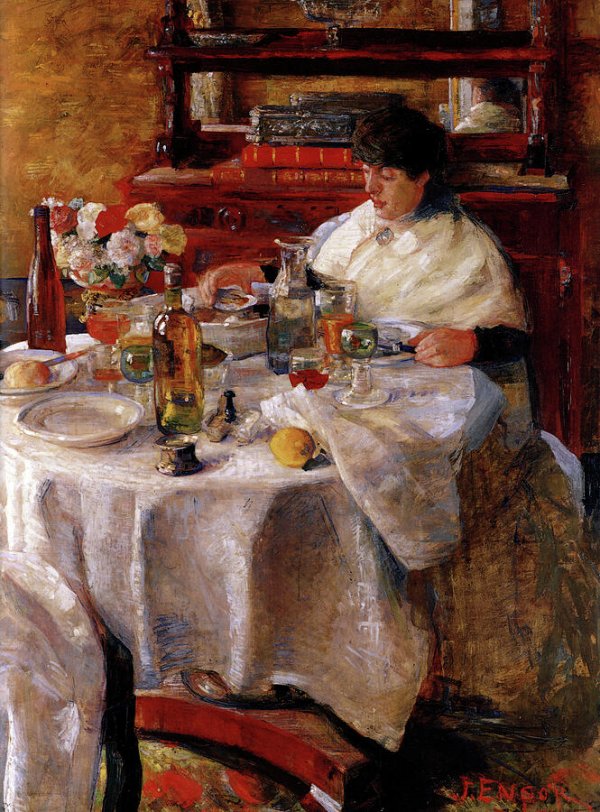
The Impressionist movement was centered in France, but other nations produced renowned Impressionist painters who worked or studied in France. Belgian painter James Ensor created The Oyster Eater in 1882. The picture features his sister Mitche seated at a lovely table, surrounded by linens and tableware. Her companion seems to have temporarily left the table, as evidenced by the discarded napkin – possibly it was the artist himself, since this and other scenes were painted in various corners of his art studio. For me this picture seems to especially capture a luxurious quality in the table linens.
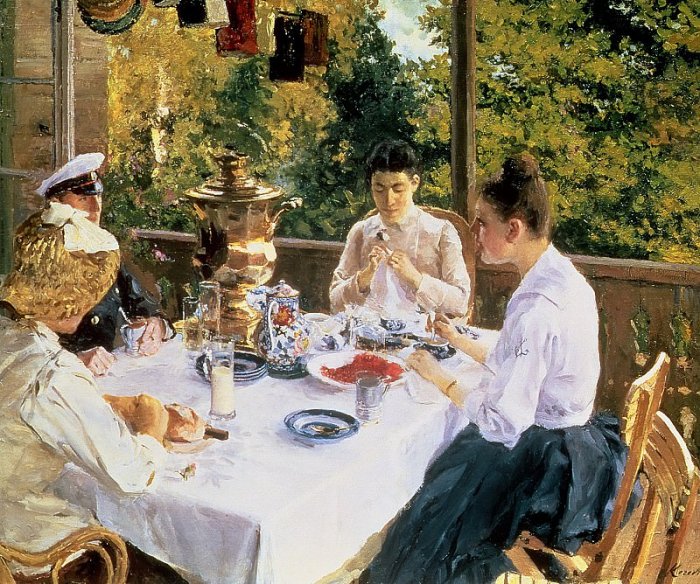
The Russian painter Konstantin Korovin was also an accomplished Impressionist. After training exclusively in Russia, he traveled to Paris in 1885 where, among the Impressionists, he later wrote that he “found everything I was scolded for back home in Moscow.” His 1888 picture At the Tea Table depicts three women and a gentleman in uniform, enjoying tea on a balcony. The picture beautifully captures an informal table and the casual figures around it. Although the tall silver samovar (hot water vessel) is prominent, I especially like the detail of the little stack of bowls.
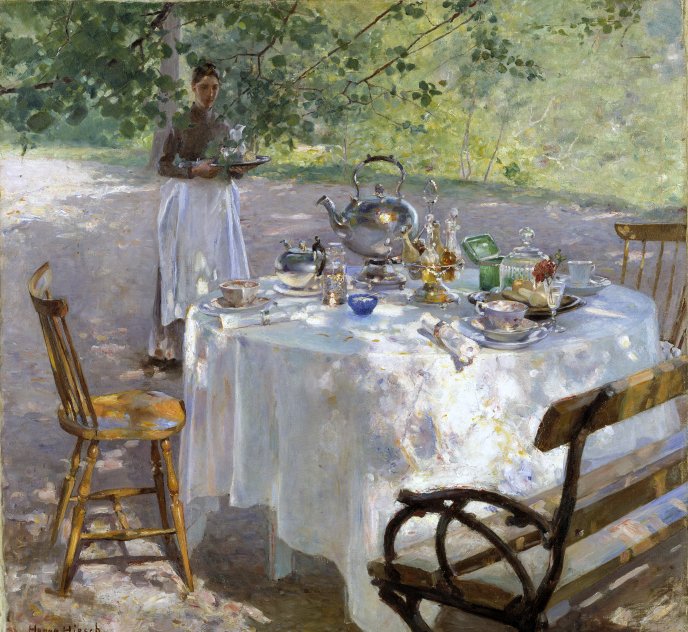
While all of the above are captivating for several reasons, my favorite of the table-themed paintings that fell within the Impressionist era has got to be Hanna Hirsch-Pauli’s Breakfast Time. Pauli was clearly influenced by Impressionism, studying in Paris during that time period, but she wasn’t technically considered an Impressionist. Still, her ability to capture ever-shifting sunlight – especially on glass and metallic surfaces, as well as fabric – was extraordinary. Breakfast Time was criticized as being “sloppy” by critics at the time, but there were also those who (like me) found – and still find – it brilliant. And just look at that cruet set!
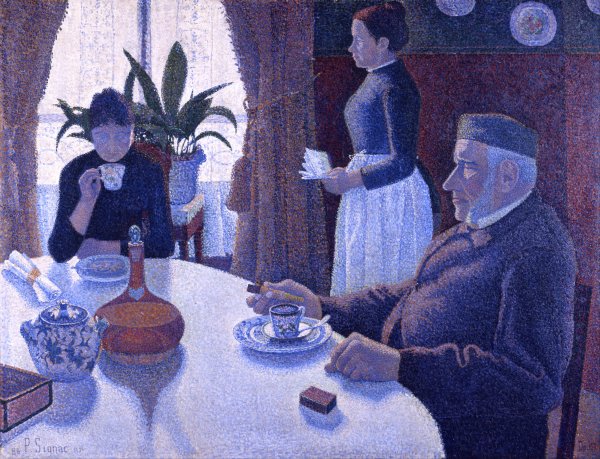
Like all art styles do, Impressionism began to evolve fairly quickly. An off-shoot of the style, which also faced harsh criticism from the traditional art community, was Pointillism. The most prominent painters here, George Seurat and Paul Signac, experimented with the way the viewer’s eye might instinctively blend tiny points of color into cohesive images. Seurat’s A Sunday Afternoon on the Island of La Grande Jatte is probably the most famous Pointillist painting. I was awed to see that picture in person in the late 1980’s at the Art Institute of Chicago, but to be honest, I do find Pointillism quite cold compared to the untamed, fleeting brushstrokes of the Impressionists. Paul Signac’s Breakfast elicits a feeling of distance between the characters, each of whom seems to be in their own little world… while the simplicity of the table contributes to the lack of warmth. The picture is a technical achievement in the Pointillist style, though, and I’m drawn to any painting that depicts pretty tableware and tea things.
As we move into the 20th century and the Post-Impressionist era, two pictures by Jules Alexandre Grun are particularly memorable: The Dinner Party in 1911, and The End of Dinner in 1913. While the former features a gorgeous porcelain tureen at the center of the table, the latter is my favorite for the gleaming silver tea things and those amazing epergnes on the table, and for the friendly faces on the Edwardian figures.
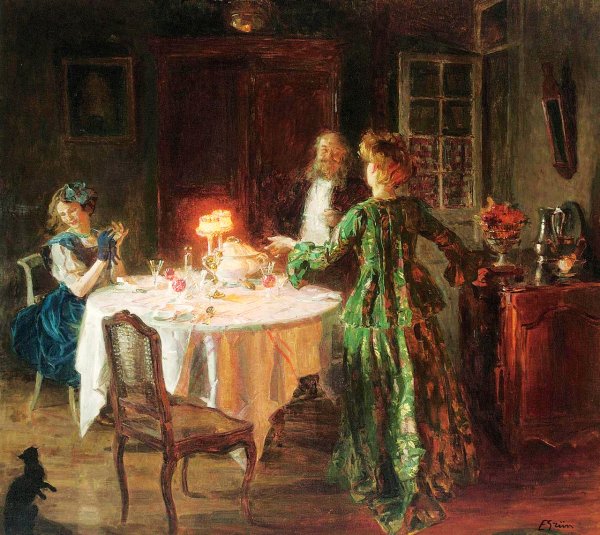
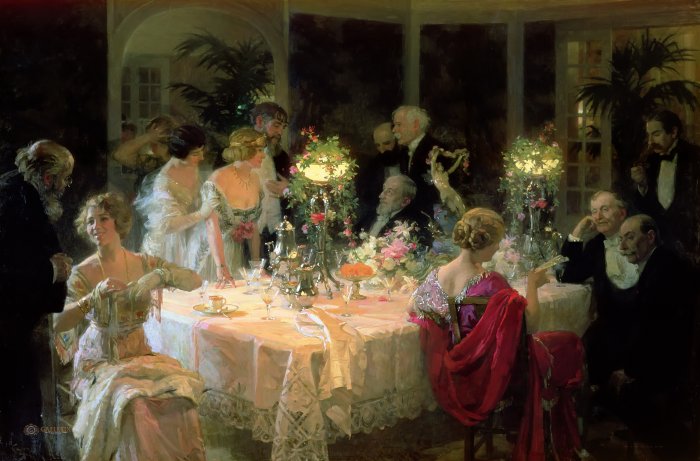
I started this journey in search of paintings depicting dining tables – specifically, I wanted evidence from the Impressionist (late Victorian) era of the use of cruet sets. Pauli’s The Breakfast Table was ultimately the most beautiful example that checked all those boxes, but in my search I also found many beautiful depictions of dining tables that are compelling for other reasons. I also found many illustrations (as opposed to paintings), particularly from the Regency era of the early 1800’s, that could easily be compiled into their own post – a project for another day!
Meanwhile, here’s an image to Pin in case you’d like to save this post for future reference!
Do you have a favorite dining-themed painting? Tell me about it in the comments!